Regaldi Ledger 2.7 ← Regaldi
LEDGERTHE SYSTEM OF RECORD
LEDGER 2.7  ·  503B  ·  21 CFR PART 11  ·  cGMP  ·  USP <797>/<800>  ·  GAMP 5

Operating ERP for sterile pharmaceutical production.

Ledger is the record a sterile-production facility runs on: every batch, every check, every signature, written down as the work happens. Because the governing regulation is recorded beside each action, the production history is inspection-ready as a byproduct of the work, not a reconstruction after it. The whole operation lives in one database: formula, batch, personnel, equipment, environmental monitoring, warehouse, distribution, and documents. A question about any of them is answered by query against one record, and the assistant reads all of it. It is built for FDA-regulated production under current Good Manufacturing Practice (compounding facilities, 503B outsourcing facilities, and contract manufacturers) and implements 21 CFR Part 11 natively from the first commit: Master Formula Studio, the electronic batch record and its six-phase gate, environmental monitoring bound to the compounding session, a SHA-256 hash-chained audit trail, and multi-signature release. The software supports the licensed operators; it does not replace a required signature.

WORKED EXAMPLE · a 503B sterile-compounding outsourcing facility. Ledger is an ERP for 503B outsourcing facilities and sterile-production operations in this regulatory class. The system carries an authored GAMP 5 Category 5 validation package; execution of the package precedes commercial activation. The SCADA and equipment-interface layer is vendor-neutral, with Siemens process equipment as the currently deployed instance. The facility is built; the system awaits commercial activation. Last verified: June 2026.

ABOUT THIS ENGAGEMENT Regaldi is the software vendor for the facility's system of record. As of this writing the facility is built and awaiting commercial activation; it has not yet produced commercial batches and has no production or inspection history. The capabilities below are functions of the software, which operates on data and configuration supplied by the facility. The software supports the facility's regulatory, quality, sterility, and Board of Pharmacy obligations; it does not replace, perform, or guarantee them. Those obligations remain the facility's responsibility under the supervision of its licensed personnel. Computerized-system validation under GAMP 5 is software validation, not FDA approval, clearance, or inspection.
F1

A skipped step is not an available action

On a gated path, a step out of order is not a low-probability event the SOP discourages. The interface does not offer it, and the database refuses it; the phase gate will not advance until the required checks are on the record. The class of error in which a step is skipped is removed by construction, not policed by training.

F2

The inspection becomes retrieval, not reconstruction

Every action is written with the operator, the server timestamp, the Master Formulation Record version, and the environmental-monitoring sample bound to that session. The record an investigator asks for already exists, assembled by the work itself, not by a week of preparation before the visit.

F3

The rule reads at the point of action

Thirty-six sections of 21 CFR Part 211 and ten USP general chapters are cited beside the step each governs, not filed in a binder and surfaced once a quarter. The operator sees the provision where the decision happens.

F4

A recall question is answered by query

From a component lot, the system resolves every batch that drew on it and every unit shipped; from a unit, the lots that fed it. The question resolves against the record, not against a reconstruction from paper.

F5

A failure cannot pass quietly

A failed filter-integrity or in-process result opens a deviation against the record in the same database transaction, and the lot is held for disposition. Where USP <797> requires a second check, the system refuses a verification in which the performer and the verifier are the same person.

The system · screen by screen

Compliance, engineered into the workflow.

One sterile-compounding batch, followed through the running system of record: authored, staffed, run through its gates, tested, released, and recorded. The system does not ask people to remember the rules. It encodes them, gates on them, and proves them. Every screen below is the actual application, populated with representative demonstration data; the facility has not yet produced commercial batches, and the records shown are illustrative.

What it is built against

The standard, by the numbers.

The regulatory provisions the workflow cites and enforces, counted from the codebase, not asserted.

Part 11electronic records
& signatures · 21 CFR
36sections of cGMP
21 CFR 211
10USP general
chapters
§503BFD&C Act ·
outsourcing facility
69permissions across
14 roles
8bounded
contexts
01Pharmacist · authoring

Every batch begins as a versioned formula.

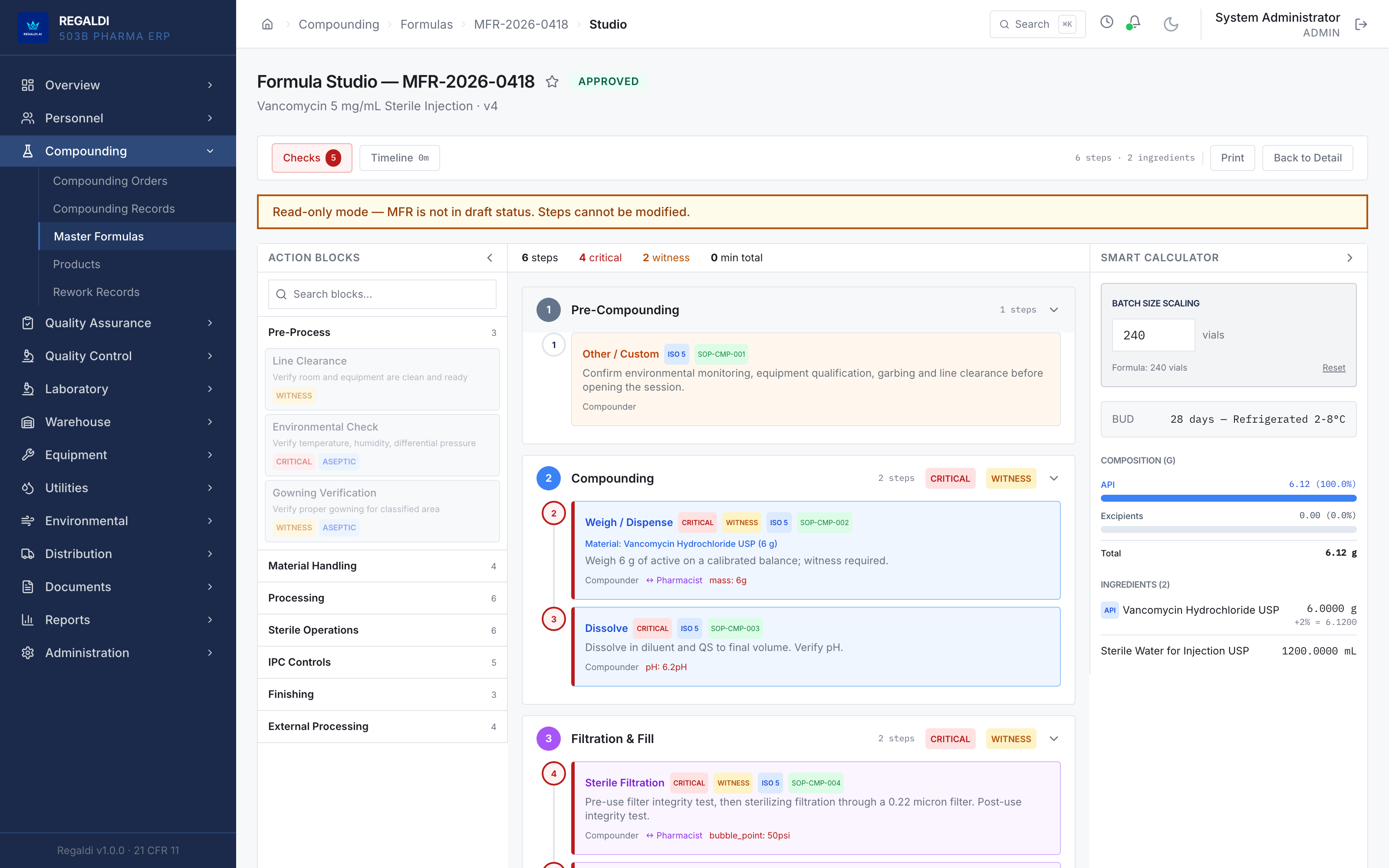
The Master Formulation Record is authored visually in Formula Studio and approved under change control: components, in-process checks, and the step sequence, as reusable action blocks.

  1. 1Versioned and approved. MFR-2026-0418, version 4, approved. Every compounding record binds to one exact MFR revision. Master production record · 21 CFR 211.186
  2. 2Built from compliant blocks. Each action block carries its required ISO class, witness role, and critical parameter. Best practice is part of the component, not a memo. USP <797>
  3. 3Scaled, not retyped. The calculator derives every quantity, overage, and concentration from the MFR for the target batch size, so the math is on the record. cGMP · 21 CFR 211.101
Formula Studio: Master Formulation Record MFR-2026-0418, version 4, approved, with action blocks, process steps, and the batch-scaling calculator.
02Compounding · Warehouse · QC · QA · Production

Only qualified people touch a batch.

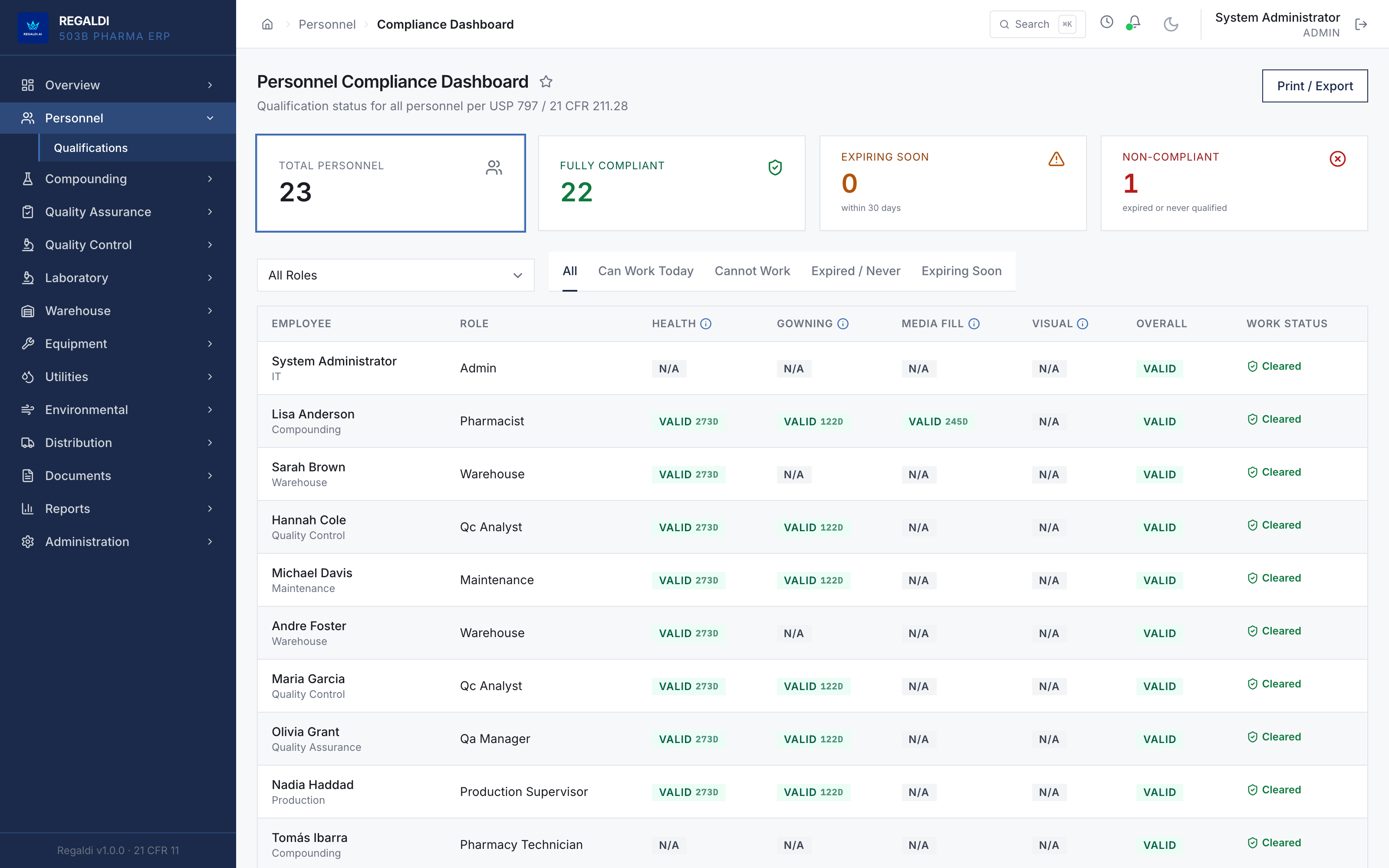
Every role that acts on a batch is qualified first, and the system blocks the work, not just warns, if a competency has lapsed.

  1. 1Every role, current. Health screening, gowning, media-fill and visual competencies are held against each person, with live status. USP <797> · 21 CFR 211.28
  2. 2It blocks, it does not remind. An expired gowning or media-fill qualification stops that person from compounding until they re-qualify. 21 CFR 211.25
  3. 3Failure routes itself. A failed qualification opens a re-qualification requirement and a deviation automatically. Return requires consecutive passes. cGMP · 211.25(d)
Personnel Compliance Dashboard: staff across compounding, warehouse, QC, QA and production with health, gowning, media-fill and visual qualification status per USP 797 and 21 CFR 211.28.
03Access control · least privilege

Compliance lives in the permissions, not the policy.

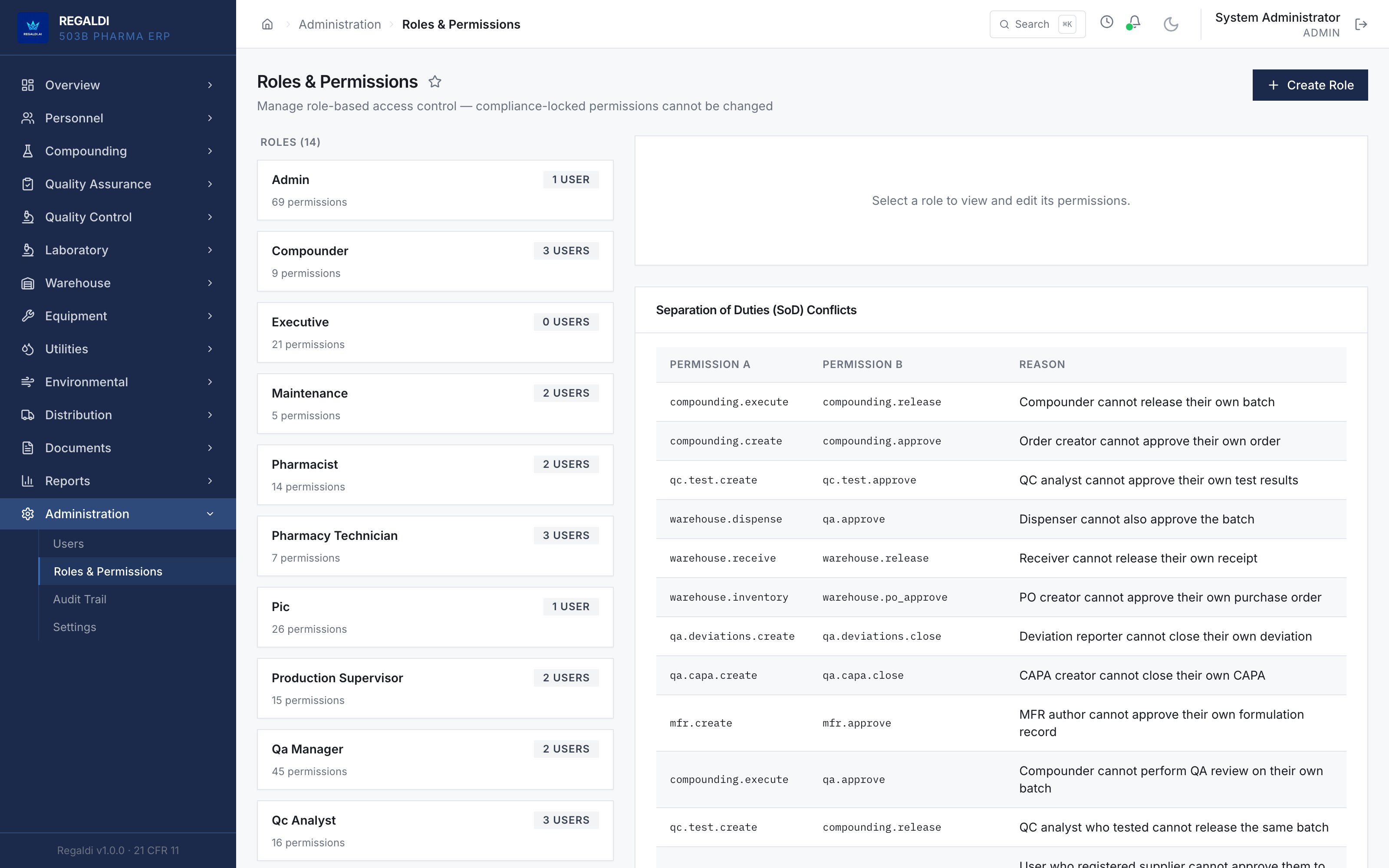
Fourteen roles and sixty-nine permissions, least-privilege by default. The access layer also enforces a separation-of-duties matrix, so a role cannot be granted a combination that breaks compliance.

  1. 1Separation of duties, in the model. Twelve conflict pairs are enforced in the access layer: the same hands cannot compound and release, test and approve, or open a deviation and close it. 21 CFR 211.22
  2. 2Compliance-locked. The permissions that carry regulatory weight are locked: they cannot be quietly edited away. 21 CFR Part 11
  3. 3Built against the standard. The workflow maps to 21 CFR Part 11, thirty-six sections of cGMP 21 CFR 211, ten USP chapters, and Section 503B of the FD&C Act. 14 roles · 69 permissions · 8 bounded contexts
Roles & Permissions: fourteen roles with granular permissions and an explicit Separation of Duties conflict matrix listing permission pairs that cannot be held together, each with a reason.
04Equipment · Metrology

Uncalibrated equipment cannot run a batch.

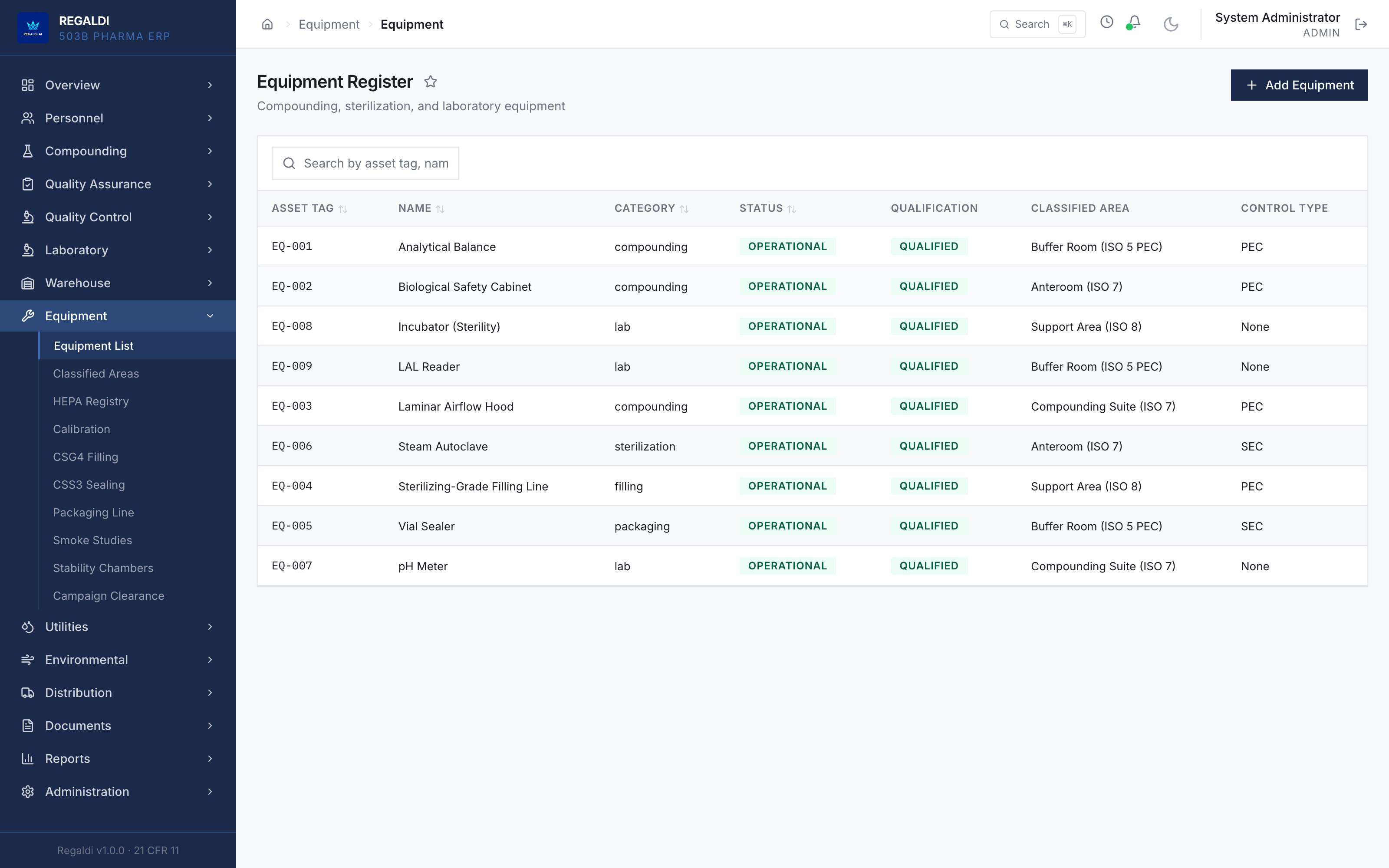
Each instrument and engineering control is qualified (DQ/IQ/OQ/PQ) and calibrated; the system gates compounding on both being current.

  1. 1Qualified and operational. A balance, hood, autoclave or filling line must read Operational and Qualified before a batch can use it. 21 CFR 211.68
  2. 2Calibration by date, not memory. If the calibration due date has passed, the equipment is blocked, checked at the moment of use. cGMP · 21 CFR 211.68(a)
  3. 3Bound to its classified area. Each unit is tied to its ISO 5/7/8 area, so the room classification travels with the work. USP <797>
Equipment Register: balances, biosafety cabinets, autoclave, filling line and lab instruments, each Operational and Qualified, tied to an ISO classified area.
05EM tech · Compounder · Operator · witness

One record runs the batch through six gates.

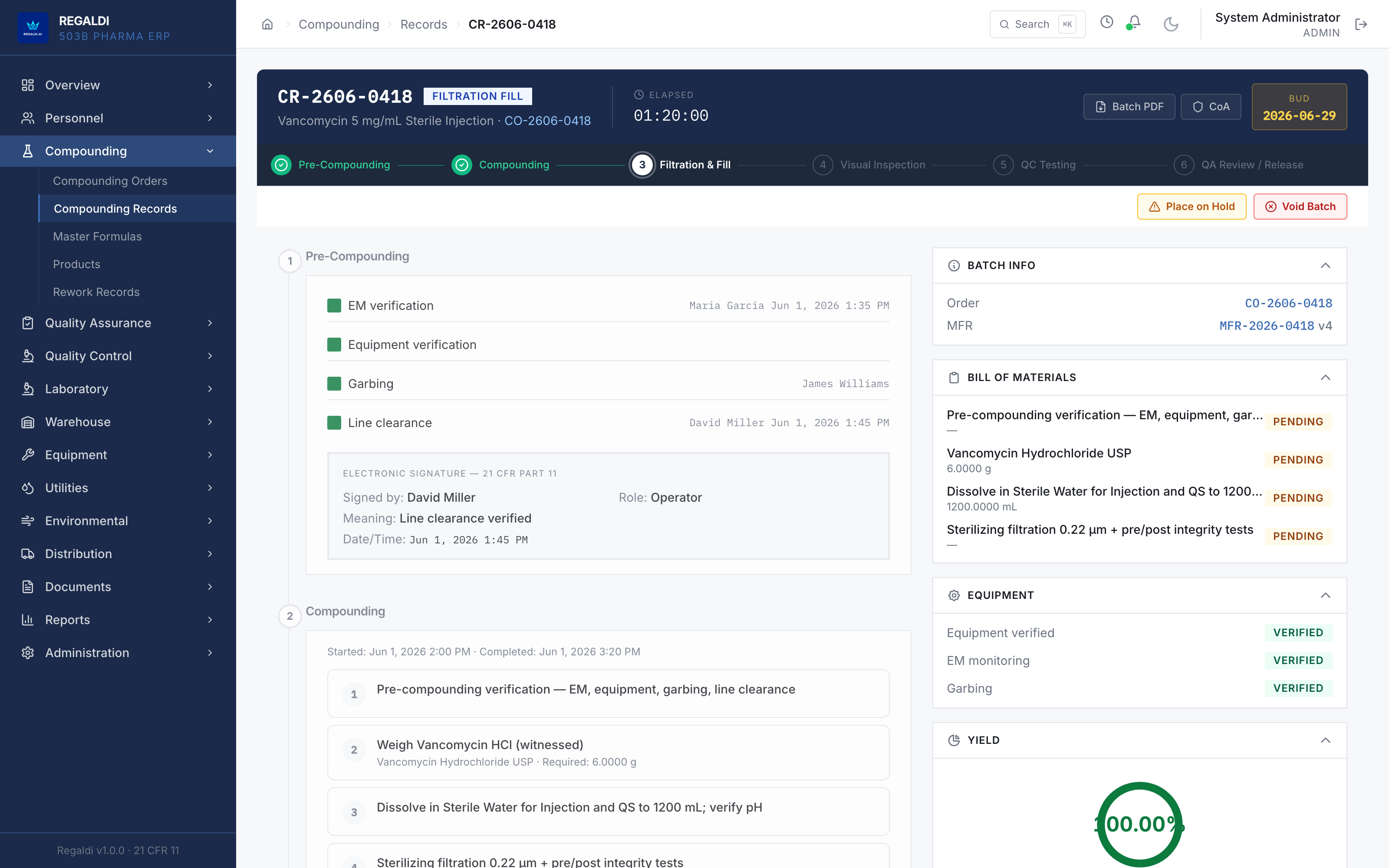
The electronic batch record advances through a six-phase gate. Each phase demands its evidence, and the database itself refuses to skip one.

  1. 1Gates enforced in the database. Pre-Compounding → Compounding → Filtration → Inspection → QC → Release. A trigger refuses any advance that lacks its evidence, even a direct edit. cGMP · 21 CFR 211.100
  2. 2Signed, with meaning. Line clearance, garbing and witnessed weighing each carry an electronic signature: name, time, and the meaning of the signature. 21 CFR Part 11 · §11.50
  3. 3Out-of-spec stops the line. An in-process check outside its range blocks the step and opens a deviation automatically. No silent excursion. 21 CFR 211.192
Compounding Record CR-2606-0418: six-phase timeline, environmental-monitoring verification, garbing and line-clearance with a 21 CFR Part 11 electronic signature, execution steps and in-process checks.
06QC Analyst · Microbiology

Nothing releases untested.

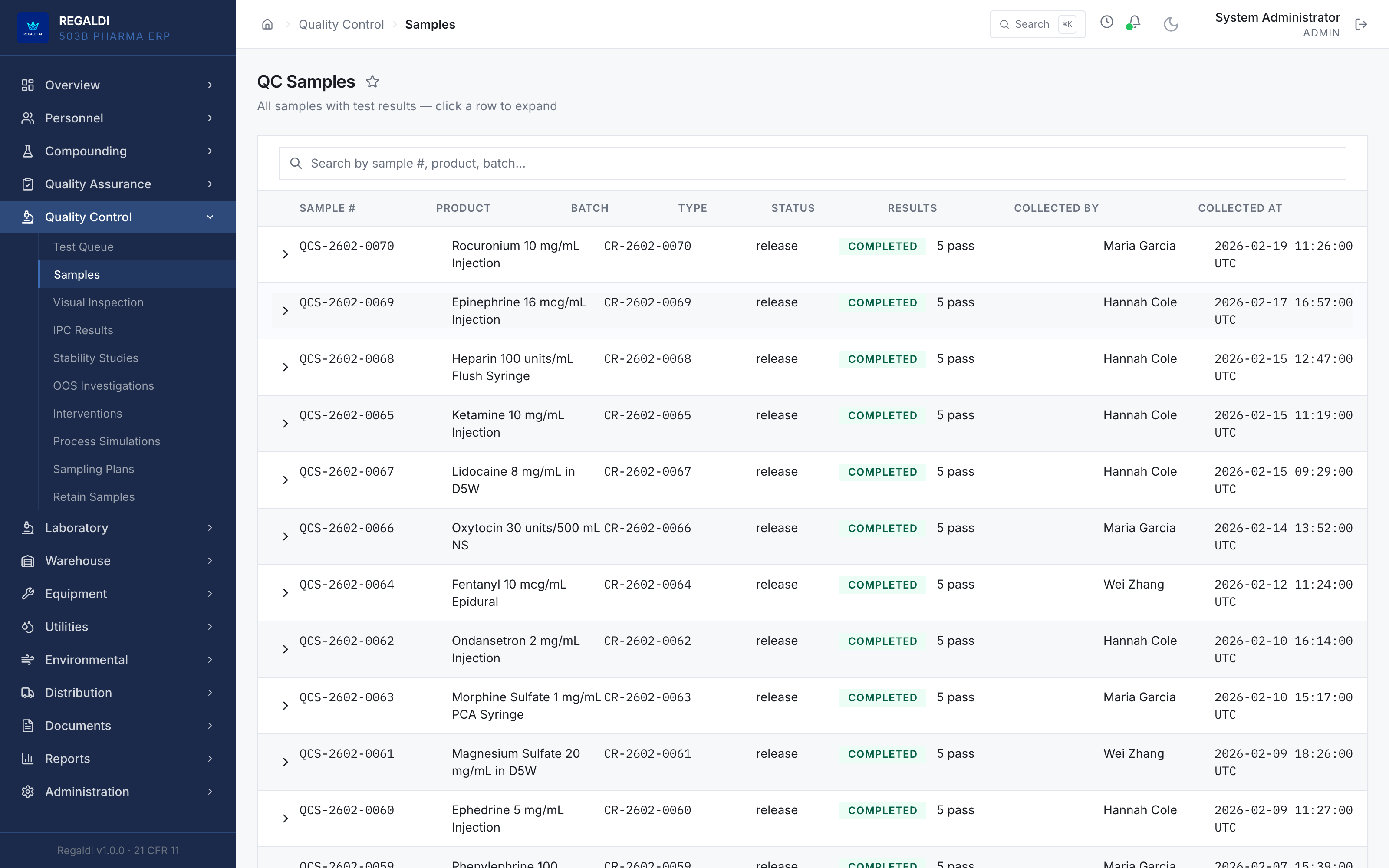
Every batch pulls a release sample and runs the compendial panel; samples and results are bound to the batch record.

  1. 1The compendial panel. Sterility, bacterial endotoxins, pH and particulate matter: each to its USP chapter, recorded pass or fail. USP <71> · <85> · <788>
  2. 2Bound to the lot. Samples and results carry the compounding-record number, collected and reviewed by named analysts. 21 CFR 211.167
  3. 3A failure becomes an investigation. An out-of-specification result opens a phased OOS investigation and holds the lot from release. 21 CFR 211.192
QC Samples: release samples per compounding record, each with five passing tests (sterility, endotoxin, pH, particulate, appearance) collected by named analysts.
07QC · QA · Pharmacist-in-Charge

No batch releases on a single signature.

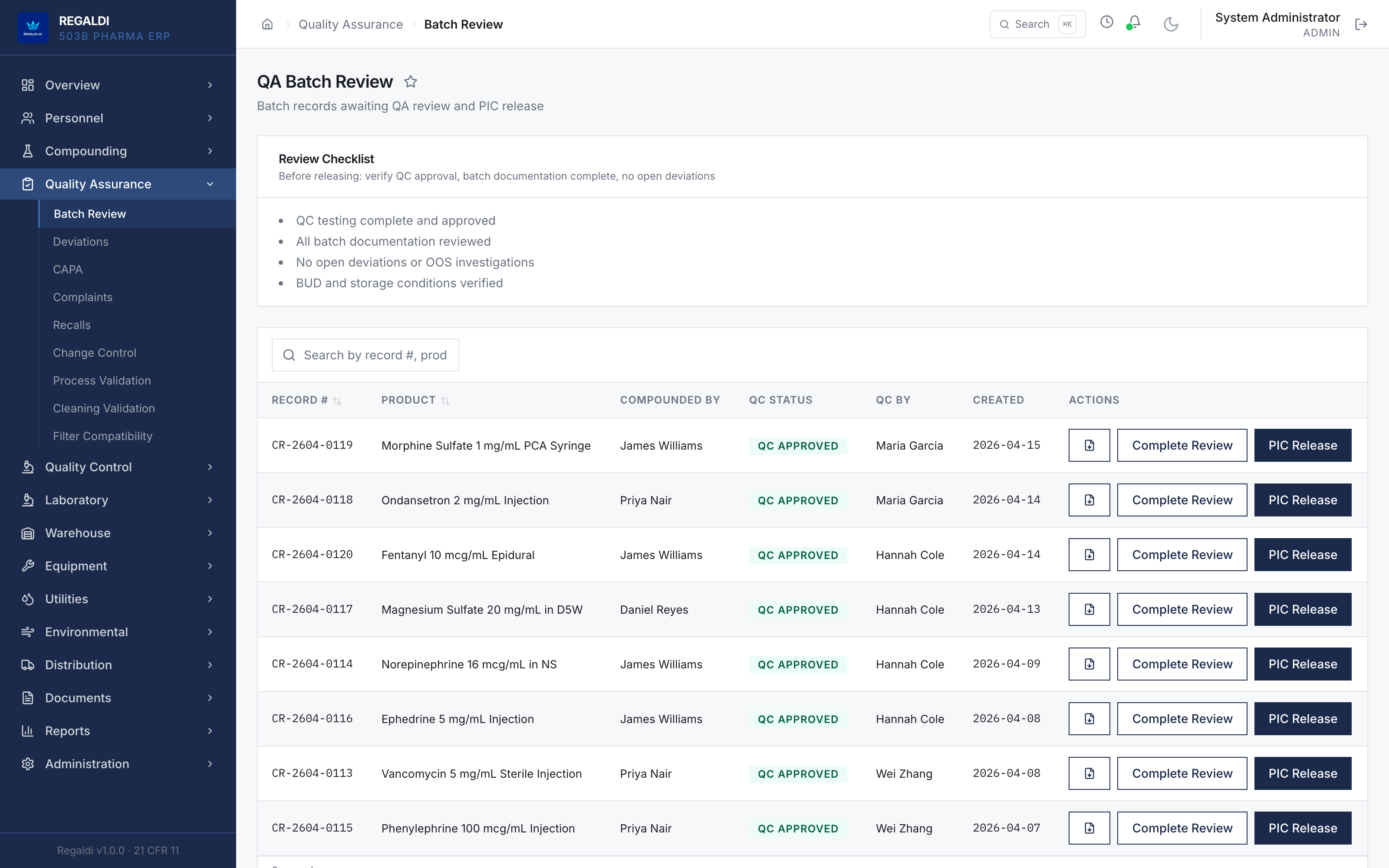
Release runs a checklist and three distinct signatures, and the system will not let one person hold two of the roles.

  1. 1The release checklist. QC approved, documentation reviewed, no open deviations or OOS, BUD and storage verified. Every item clears before release. cGMP · 21 CFR 211.192
  2. 2Three signatures, separated. QC approval, QA review, then the Pharmacist-in-Charge: distinct signatures, and the releaser is never the compounder. 21 CFR 11.200(a) · 211.22
  3. 3Segregation, enforced in code. The same person cannot complete and verify, or compound and release. The system refuses it. 21 CFR 211.22
QA Batch Review: records awaiting QA review and PIC release, each QC-approved, with a release checklist and Complete Review / PIC Release actions.
08Every action · system-wide

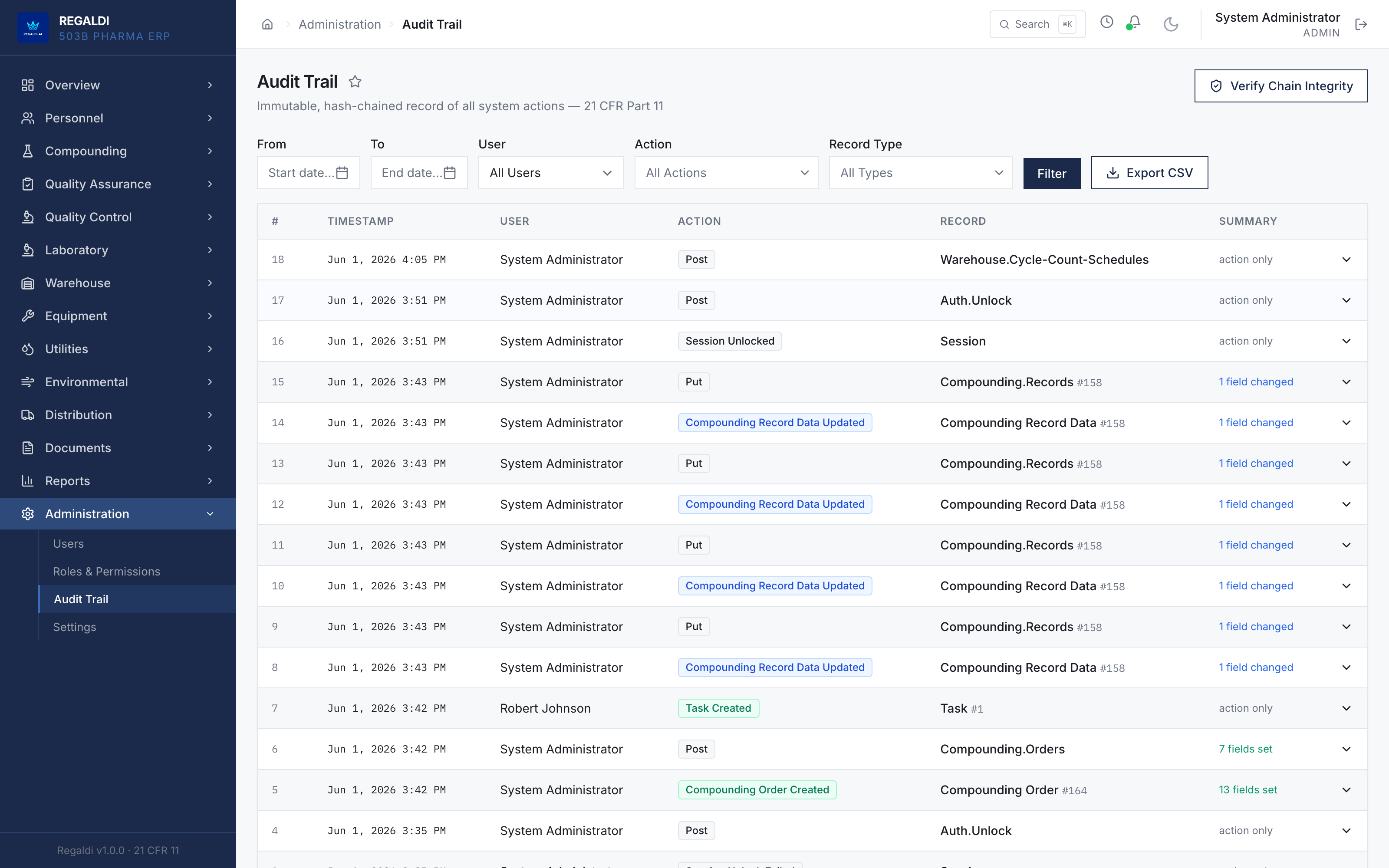
Every action is hash-chained, and verifiable on demand.

The audit trail records who did what and when, with each entry cryptographically chained to the one before it.

  1. 1Chained by SHA-256. Each entry carries a hash bound to its predecessor; an alteration or deletion breaks the chain. 21 CFR Part 11 · §11.10(e)
  2. 2Walk-and-verify. Chain integrity is verified on demand. The design is tamper-evident: it makes a change detectable rather than preventing the write. Tamper-evident, not tamper-proof
  3. 3The record refuses to forget. Update and delete on the audit log are blocked at the database itself. Data integrity · ALCOA+
Audit Trail: SHA-256 hash-chained record of all system actions, with a per-entry hash column and a Verify Chain Integrity action.
09Every role · shop floor

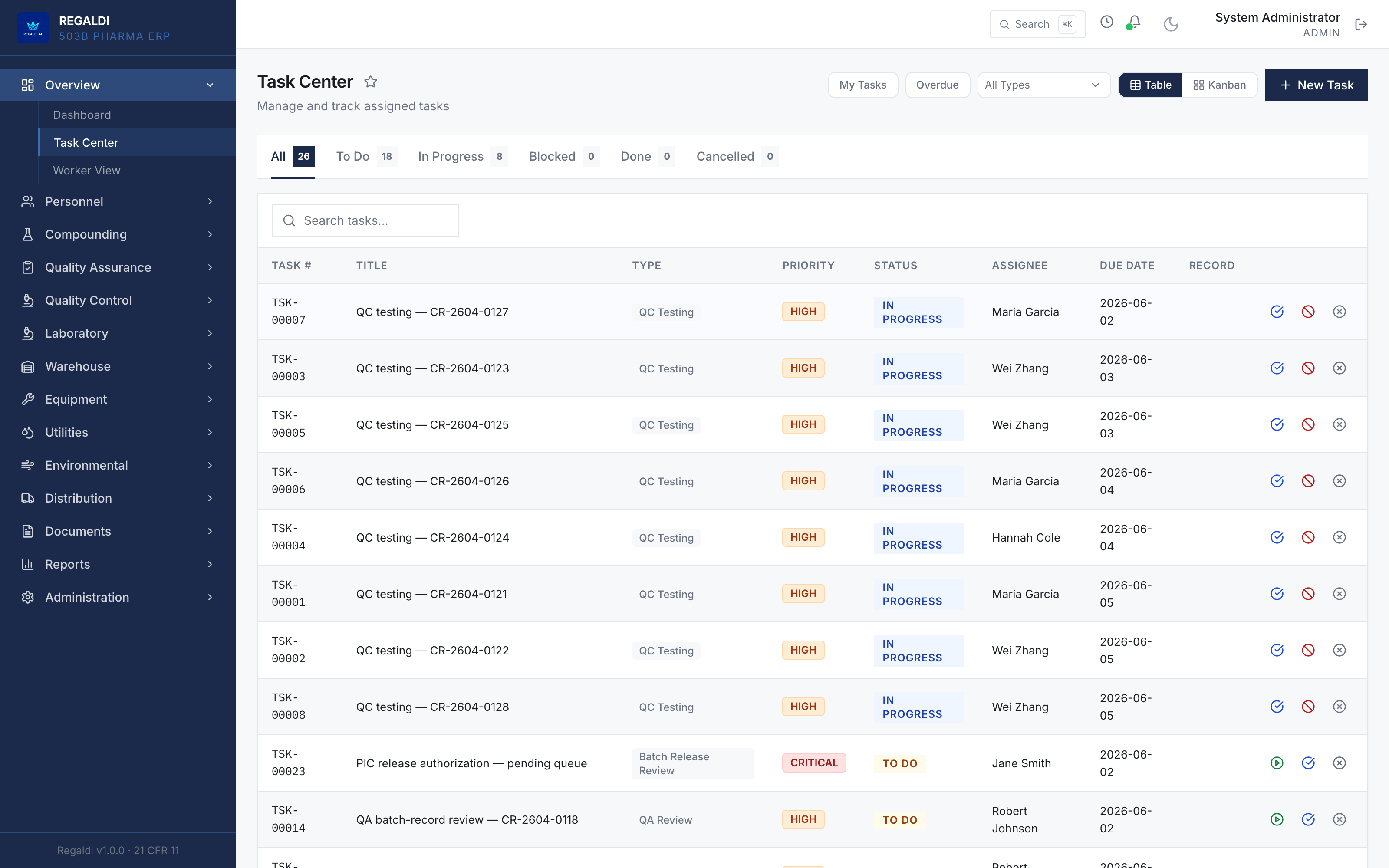
The work routes itself to the right hands.

A change of state in the process creates and assigns the next task (QC testing, QA review, a release authorization) to the right role, automatically.

  1. 1Tasks from process, not memory. When a batch reaches QC, the QC task appears and is assigned; nothing waits on someone remembering. cGMP · 21 CFR 211.100
  2. 2Routed by role, by load. Each task lands with the role that owns it, balanced across the team, and linked back to its batch. Separation of duties · 211.22
  3. 3One click to the record. Every task opens straight into the batch it belongs to. The Worker View keeps the floor moving. Worker View · shop-floor
Task Center: tasks generated from process state (QC testing, QA review, PIC release) assigned to the right people, linked back to their batch records.
10Warehouse · command center

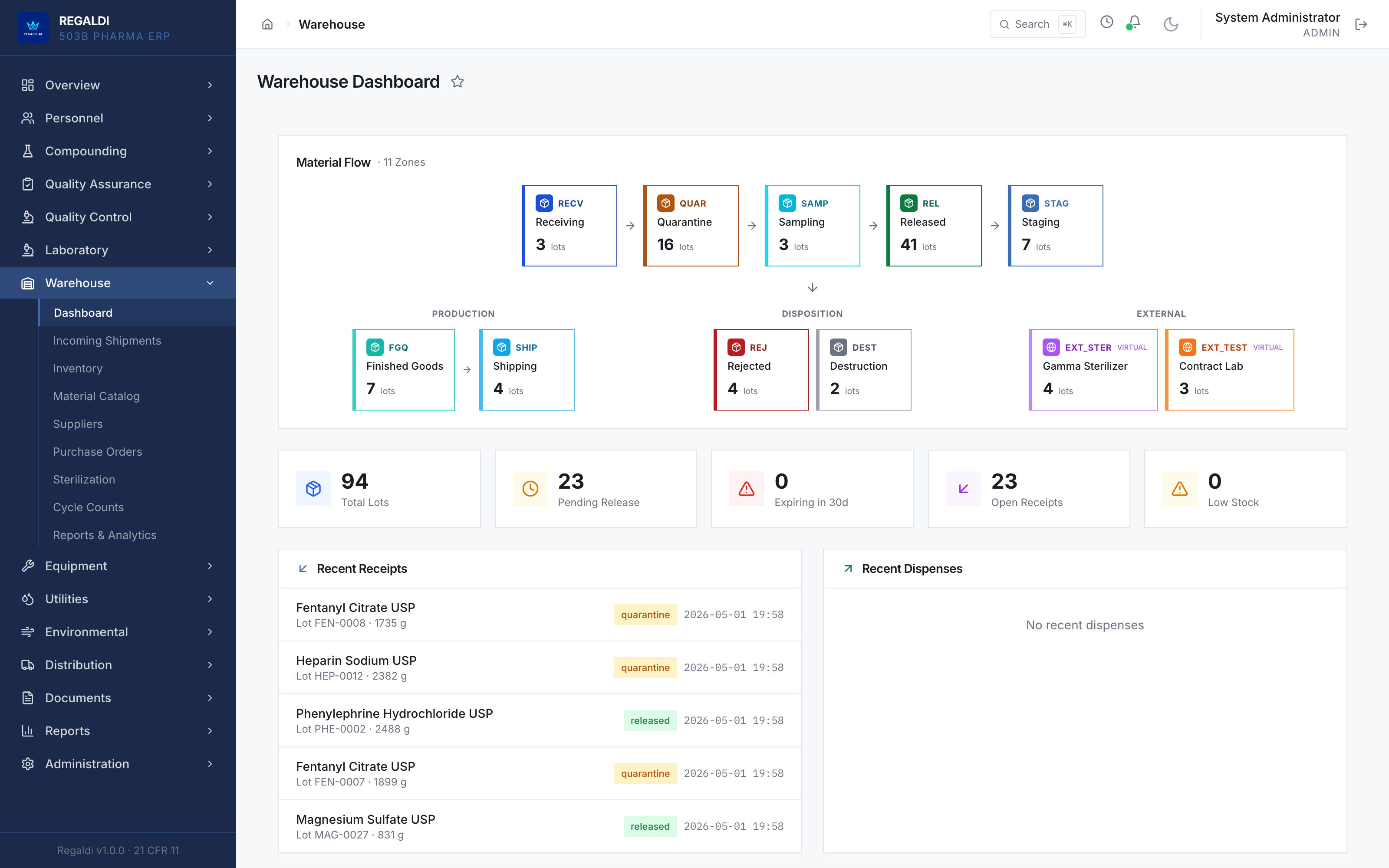
The whole floor, at a glance.

Every material lot flows through named zones (receiving, quarantine, sampling, released, staging, disposition) with live counts, so nothing is dispensed before it is released.

  1. 1Material flow, by zone. Eleven zones from receiving to released to disposition; quarantined and rejected lots are held apart, physically and logically. cGMP · 21 CFR 211.142
  2. 2Release pressure, visible. Pending releases, open receipts and low stock surface as live numbers, not a monthly report. Operational control
  3. 3Nothing slips a zone. A lot cannot be used until it leaves quarantine into released storage. The floor view is the proof. 21 CFR 211.80
Warehouse Dashboard: a material-flow map across eleven zones with live lot counts, plus pending releases, open receipts and recent receipts.
11Warehouse · Distribution

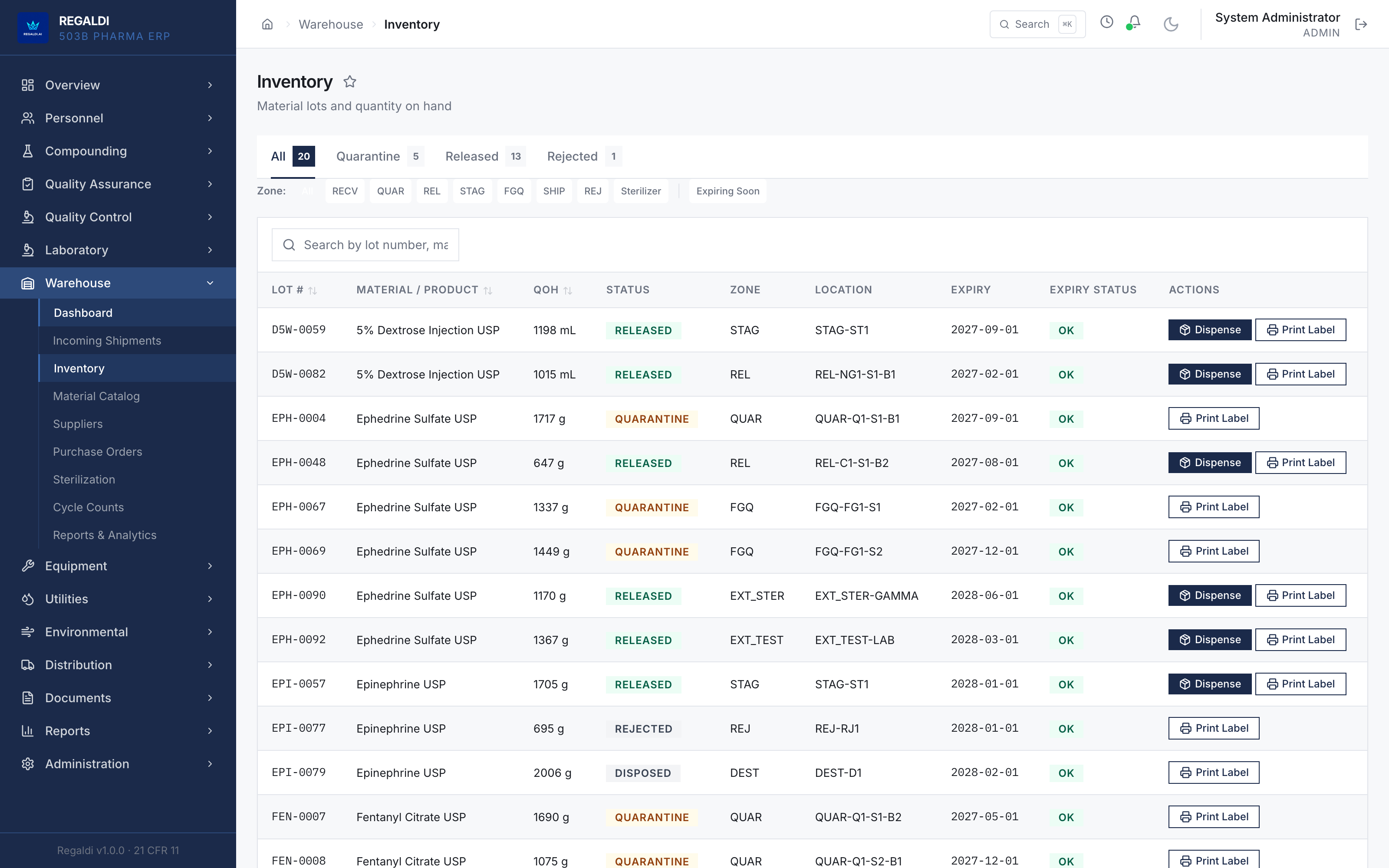
From component lot to the unit shipped, both ways.

Every material lot is tracked by zone and bound into the batches that drew on it, so a recall is answered by query, not by paper.

  1. 1Released, by zone. Material moves through receiving, quarantine and released storage; a quarantined lot cannot be dispensed. cGMP · 21 CFR 211.142
  2. 2First-Expired, First-Out. Dispensing enforces FEFO. Using a later lot before an earlier one requires a signed reason. 21 CFR 211.150
  3. 3Recall, by query. From a component lot the system resolves every batch and every unit shipped. In seconds, not paper. 21 CFR 211.196 · Part 7
Warehouse Inventory: material lots by zone (receiving, quarantine, released) with quantity on hand, expiry, and dispense / print-label actions.
01

The System of Record: A Sterile-Manufacturing ERP Across Eight Bounded Contexts

The worked example below is a 503B sterile-compounding outsourcing facility. Ahead of its launch, Regaldi delivered the system of record it is built to operate under: seventy-seven modules organized into eight bounded contexts: Compounding, Quality, Personnel, Equipment, Environmental Monitoring, Warehouse, Distribution, and Documents. The structure is designed to support the facility's obligations under current Good Manufacturing Practice and the compounding provisions of Section 503B of the Federal Food, Drug, and Cosmetic Act. The system is complete, with a GAMP 5 Category 5 validation package authored against it; execution of that package precedes commercial activation. The facility is built and awaiting that activation.

02

Master Formula Studio: Authoring the Master Formulation Record Under Change Control

Compounding begins with the Master Formulation Record. Master Formula Studio is the visual environment in which a formulation is authored and versioned under change control: components, quantities, in-process checks, and step sequence. Each Master Formulation Record carries a version identity that every downstream compounding record is bound to, so a compounding record can always be read against the exact MFR revision under which it was executed.

03

Batch Cockpit: The Electronic Batch Record and Its Six-Phase Gate

Batch Cockpit is the electronic batch-record surface for a compounding record. The record advances through a six-phase state machine designed to block phase advancement until the requirements the facility configures are satisfied of record: environmental-monitoring verification and equipment qualification before the session opens, garbing and line-clearance confirmation at entry, filter-integrity and container-closure checks at fill, and the in-process checks each gate prescribes. The gates are enforced by the system rather than left to manual reminder; any exception is routed through the facility's documented deviation procedure and written to the record.

04

Environmental Monitoring Bound to the Compounding Record

Environmental monitoring is bound in the system of record to the compounding session it covers. The viable and non-viable air samples, the surface samples, and the personnel fingertip samples are recorded against the specific compounding record, not filed separately, so the conditions under which a given lot was compounded are available for review as part of that lot's record, in keeping with USP General Chapters <797> and <800>.

05

The Hash-Chained Audit Trail: Tamper-Evident Records Under 21 CFR Part 11

Every action in the system is written to a tamper-evident audit trail in which each entry is cryptographically chained to the one before it by SHA-256 hash, so that any alteration or removal breaks the chain and is detectable on a walk-and-verify. Electronic signatures carry the signer's printed name, the date and time, and the meaning of the signature, consistent with 21 CFR Part 11 sections 11.50 and 11.70, and each signature is bound to a hash of the record's content at signing time. Each signature is executed with two distinct identification components in accordance with 21 CFR 11.200(a), re-authenticated at signing; multi-factor authentication governs system access, and the signing layer is designed to prevent one operator from signing as another.

06

Multi-Signature Release: Segregation of Duties and Part 11 Electronic Signatures

No compounding record releases on one signature. Release requires the quality-control approval, the quality-assurance review, and the Pharmacist-in-Charge authorization, each captured as a distinct electronic signature, re-authenticated at the moment of signing, with the originating IP address and user-agent recorded. The PIC release authority remains with the licensed pharmacist; the software gates the sequence and records it, and does not sign on anyone's behalf.

07

Lot Traceability, Component Lot to Unit: Bidirectional Genealogy for Recall

Traceability runs in both directions. From an incoming component lot, the system resolves every compounding record that drew on it and every unit shipped; from a finished unit, it resolves the Master Formulation Record version, the compounding record, the environmental-monitoring samples bound to the session, the personnel who executed each step, and the component lots that fed it. When a recall question arises, the system is built to answer it by query rather than by reconstructing paper, resolving the affected lots and the recipients each shipped to, in keeping with the lot-level batch and distribution records cGMP requires.

08

Quality Events: OOS, Deviation, CAPA, and Change Control

Quality events are handled within the same record, not in a separate binder. When a result falls out of specification, the compounding record is held from advancing; the system opens an out-of-specification (OOS) investigation through its phased sequence, links the deviation and any resulting corrective and preventive action (CAPA) to the record, and holds the lot in quarantine until disposition. Change control governs revisions to a Master Formulation Record, and the annual product review draws on the records already bound to each lot.

How is the system validated?

As a custom-developed application, it follows a GAMP 5 Category 5 approach: computerized-system validation spanning design, installation, operational, and performance qualification, each traceable to a documented user requirement. The validation package is authored; its execution precedes commercial activation. Computerized-system validation is software validation, not FDA approval, clearance, or inspection.
Can a compounding record be released on a single electronic signature?

No. Release requires distinct electronic signatures from quality control, quality assurance, and the Pharmacist-in-Charge, each executed with two distinct identification components in accordance with 21 CFR 11.200(a) and recorded under sections 11.50 and 11.70, with segregation of duties enforced in the release sequence. The first signing in a continuous session uses all components; each subsequent signing uses at least one component unique to the signer.

How is the audit trail made tamper-evident?

Each audit entry is cryptographically chained to its predecessor by SHA-256 hash, so any retroactive alteration breaks the chain and is detectable on a walk-and-verify. This is tamper-evident, not tamper-proof: the chain makes a change detectable rather than preventing the underlying write.

Is the system tied to a particular SCADA or equipment vendor?

No. The SCADA and equipment-interface layer is a vendor-neutral architecture; Siemens process equipment is the currently deployed instance. Environmental and equipment data are bound to the compounding record through an integration layer rather than a single proprietary dependency.

Where does the data reside, and how is it hosted?

Each facility runs on dedicated, isolated infrastructure rather than a shared multi-tenant pool, and the deployment region is chosen so the facility controls where its data physically resides. Hosting is provisioned per engagement under the written engagement letter.

Can the system of record be deployed at another 503B facility?

Yes. The architecture separates the core from facility-specific configuration (master formulation records, equipment registers, monitoring plans), so a second outsourcing facility can be provisioned under written engagement letter, subject to that facility’s own validation and qualification.

How is an engagement priced?

Under a written engagement letter with a defined scope and deliverables. Each engagement opens with a process and compliance audit, delivered as a written architecture and remediation plan; the build that follows is scoped and priced from that plan. Terms are stated in the letter before work begins.

Engage the architects.

If a sterile-compounding or manufacturing facility is being stood up or re-validated, Regaldi will walk the VP of Quality and the Pharmacist-in-Charge through how this system of record enforces release gates, electronic signatures, environmental-monitoring binding, and lot traceability. The core is deployable at additional sterile-production facilities under written engagement letter, configured and validated for each facility's own scope. To request a technical review, write to the principal at office@regaldi.ai.