Electronic Records & Signatures
Records, audit trail, and signatures built to the rule from the first commit.
10 / 10 provisions mapped
to a mechanism
to a mechanism
A regulated system earns trust one provision at a time. This page maps the functions of the system of record to the specific rules they are engineered to support, in the language a director of quality reads. Each line below describes what the software does, verified in the codebase. None of it stands in for the licensed operator who signs.
READ THIS FIRST The controls described here are functions of the software. They operate on the data and configuration a facility supplies, and they support, rather than replace, perform, or guarantee, that facility's regulatory, quality, sterility, and Board of Pharmacy obligations. Those remain the facility's responsibility under its licensed personnel. Computerized-system validation under GAMP 5 is software validation, not FDA approval, clearance, or inspection.
Records, audit trail, and signatures built to the rule from the first commit.
Production, quality, labeling, and distribution recordkeeping across eight bounded contexts.
Second-check verification, environmental monitoring bound to the session, beyond-use dating.
Lot-level batch and distribution records sized for an outsourcing facility under Section 503B.
Part 11 is not a badge. It is a set of requirements for electronic records and signatures, each of which a system either meets in code or does not. Here is every provision that applies, beside the function that carries it.
The provisions in the ledger above are not a roadmap. Below are screenshots from a working instance of the system of record, populated with representative demonstration data and captured as an operator meets them: the signature, the trail, and the batch record itself.
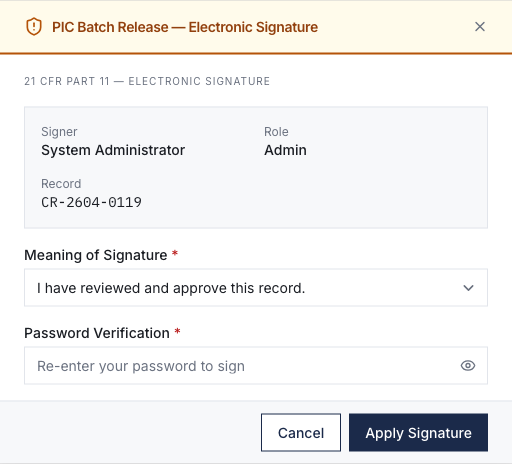
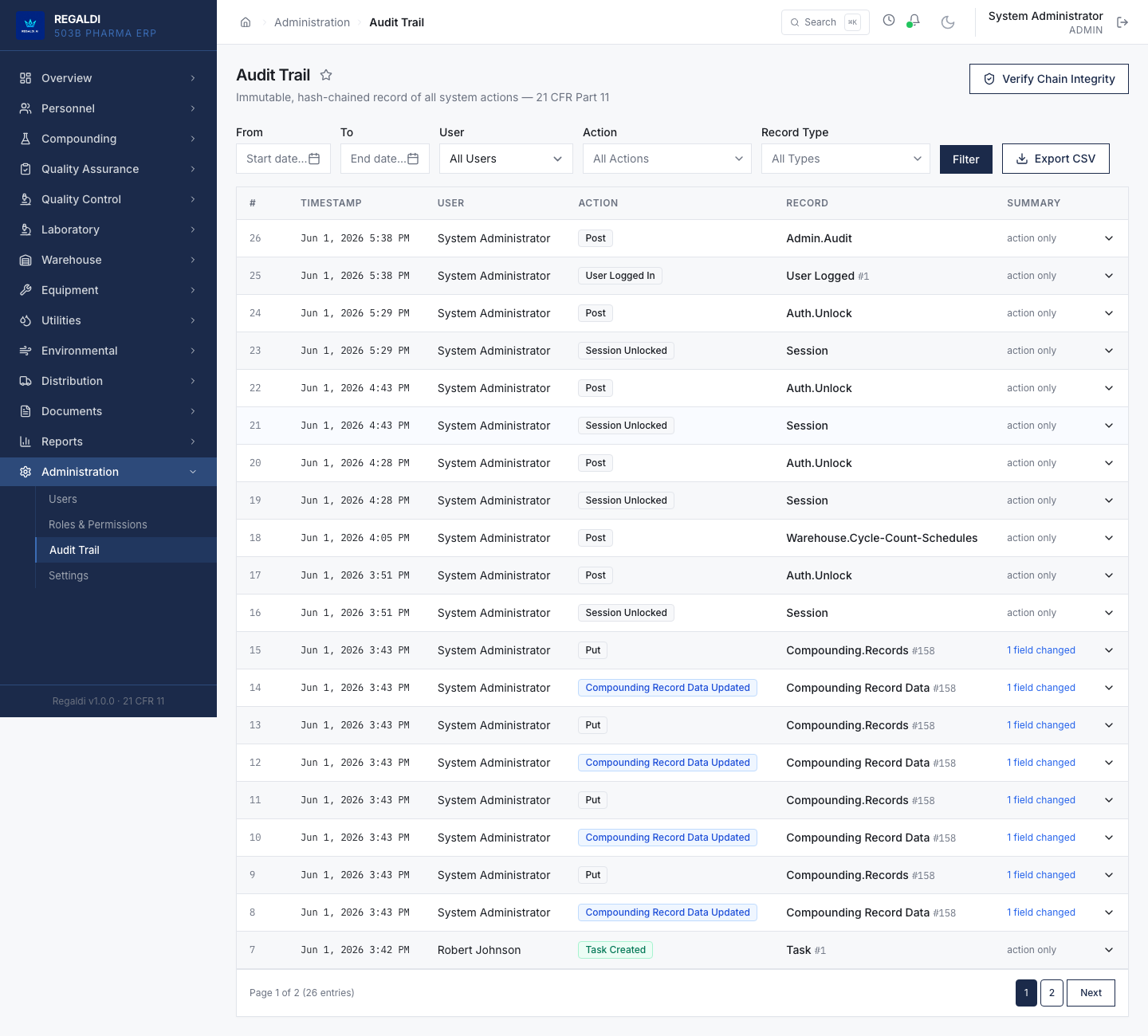
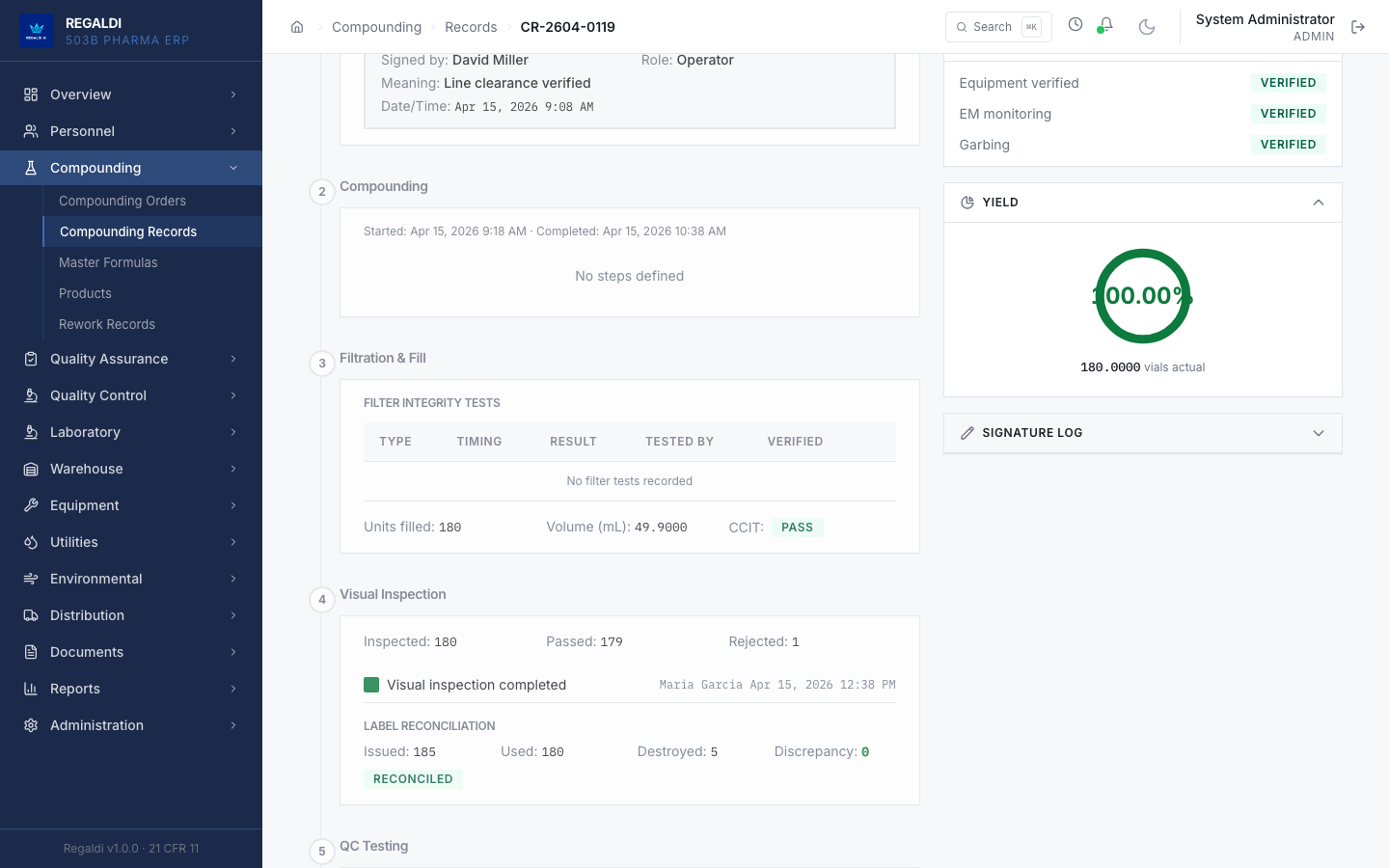
A document that says a check happened is a record. A system that will not advance until the check happens is a control. On a gated path, a skipped step is not a low-probability event; it is not an available action, and the error class is removed by construction rather than policed by training. These four are enforced at the database layer, where the interface cannot route around them.
A compounding record moves through a six-phase state machine. The system holds the record from advancing until the checks each phase prescribes are satisfied of record. Filter-integrity, container-closure integrity, quality-control approval, and release are gated at the database layer, so the sequence cannot be advanced from the interface alone.
Where a step requires a second check, the system refuses a verification in which the verifier and the operator who performed the step are the same person. The second-check expectation of USP <797> is carried in the record, not left to a reminder.
When a filter-integrity test or an in-process check is recorded as a failure, the system opens a deviation against that compounding record within the same write. A failure cannot be recorded without a deviation following it, and the record is held for disposition.
Release requires quality-control approval, quality-assurance review, and Pharmacist-in-Charge authorization, each captured as a distinct electronic signature. The system refuses release if one operator holds more than one of those roles on the same record. The release authority remains with the licensed pharmacist; the software gates and records the sequence.
This boundary is the point. AI augments the operator and never replaces them. The system makes the right action the only available one and the wrong one hard to take, then leaves the judgment, and the signature, with the licensed professional who carries the consequence.
No software does. Compliance is a property of how a facility validates and uses a system, of its written procedures, and of its personnel. What this system provides is the record, audit-trail, and signature controls a facility’s quality system can rely on, engineered to the rule rather than retrofitted to it.
It is tamper-evident, not tamper-proof. Each entry is cryptographically chained to the one before it by SHA-256 hash, so a retroactive change breaks the chain and is detectable on a walk-and-verify. The chain makes alteration visible rather than physically preventing a write.
A facility configures which checks each phase requires. The hard controls, including multi-signature release and the separation-of-duties refusal, are not operator-toggleable. They are enforced in the release sequence at the database layer.
No. Computerized-system validation under GAMP 5 is software validation performed by the vendor and the facility, not FDA approval, clearance, or inspection. The capabilities described here are functions of the software, which operates on data and configuration supplied by the facility.
Quality and regulatory leaders are welcome to walk this mapping line by line against a facility's user-requirement specification. Regaldi will take the VP of Quality and the Pharmacist-in-Charge through how the system of record enforces release gates, electronic signatures, environmental-monitoring binding, and lot traceability, and where the facility's own validation begins.