Regaldi Herald 6.3 ← Regaldi
HERALDTHE OPERATING CRM
HERALD 6.3  ·  503A  ·  USP <795>  ·  USP <797>  ·  STATE BOARD OF PHARMACY

Operating CRM for regulated healthcare sales.

Herald runs the selling and dispensing side of a pharmacy in one system, and it made one seventeen-year practice roughly twenty times faster at the operator's workstation. A herald carried the word and returned with the answer; this one does the same for the pharmacy: prescribers, outreach, follow-ups, and the orders they produce, held in one controlled system. It serves pharmacies that market and dispense medication under state Board of Pharmacy frameworks, from retail to compounding to prescriber-direct practices; a compounding pharmacy is the worked example below. It structures the order pipeline, the prescriber queue, and the dispensing and verification workflow. Inventory rotates First-Expired, First-Out on the assigned Beyond-Use Date under USP General Chapters <795> and <797>, and controlled substances reconcile to a perpetual inventory. Selective machine assistance is applied only where simplification and automation alone are insufficient to meet the standard, and never in place of a required pharmacist signature.

WORKED EXAMPLE · a seventeen-year compounding practice serving 1,700+ active doctors and clinics across the United States. The Regaldi engagement commenced in 2025. Order-processing time at the operator workstation was reduced roughly twentyfold (timed at the workstation, before and after), and gross revenue doubled over the engagement period. At every release, the final-verification signature is preserved with the verifying pharmacist; the Pharmacist-in-Charge remains accountable for dispensing under the pharmacy's permit. References are available upon request.

The operation · screen by screen

Order, engineered into the dispensing pipeline.

One compounding pharmacy’s commercial operation, followed through the running CRM: the book of prescribers, the order pipeline, the documented call, the signed release, the result, and the monthly review. The system does not ask operators to remember the workflow. It structures it, records each step, and keeps the pharmacist’s signature where the law puts it. Every screen below is the actual application, populated with representative demonstration data: no client or patient information is shown, and the figures visible on the screens are illustrative.

What it is measured against

The engagement, by the numbers.

The provable outcomes of the deployment at a 17-year compounding pharmacy, and the regulatory frame the workflow runs under. Measured, not asserted.

1,700+active doctors
& clinics
20×order-processing
time reduced
gross revenue,
over the engagement
17 yrcompounding
practice
503AUSP <795> / <797>
dispensing
Humansignature at
every release
01Order intake · AI assist

Email comes in. A draft order goes out.

Inbound orders and questions arrive as email. The assistant reads each one, extracts the prescription, matches the prescriber and patient, reuses the prior fill pattern, and prepares a draft for a person to approve and the pharmacist to sign. Most of the keying disappears.

  1. 1Read, extracted, drafted. Each inbound email is parsed into a structured draft of items, quantities, prescriber, and patient, with a confidence score on every extraction, in seconds. Scored extraction
  2. 2Patterns reused, not retyped. When the prescriber and patient are known, the assistant reuses the last fills and the active price book, so a clean reorder is one click to approve. Pattern reuse
  3. 3A human approves and signs. Nothing dispenses on the draft alone. Every order waits on a review and the pharmacist’s signature. Complaints are classified and routed, not auto-closed. Under signature · HIPAA
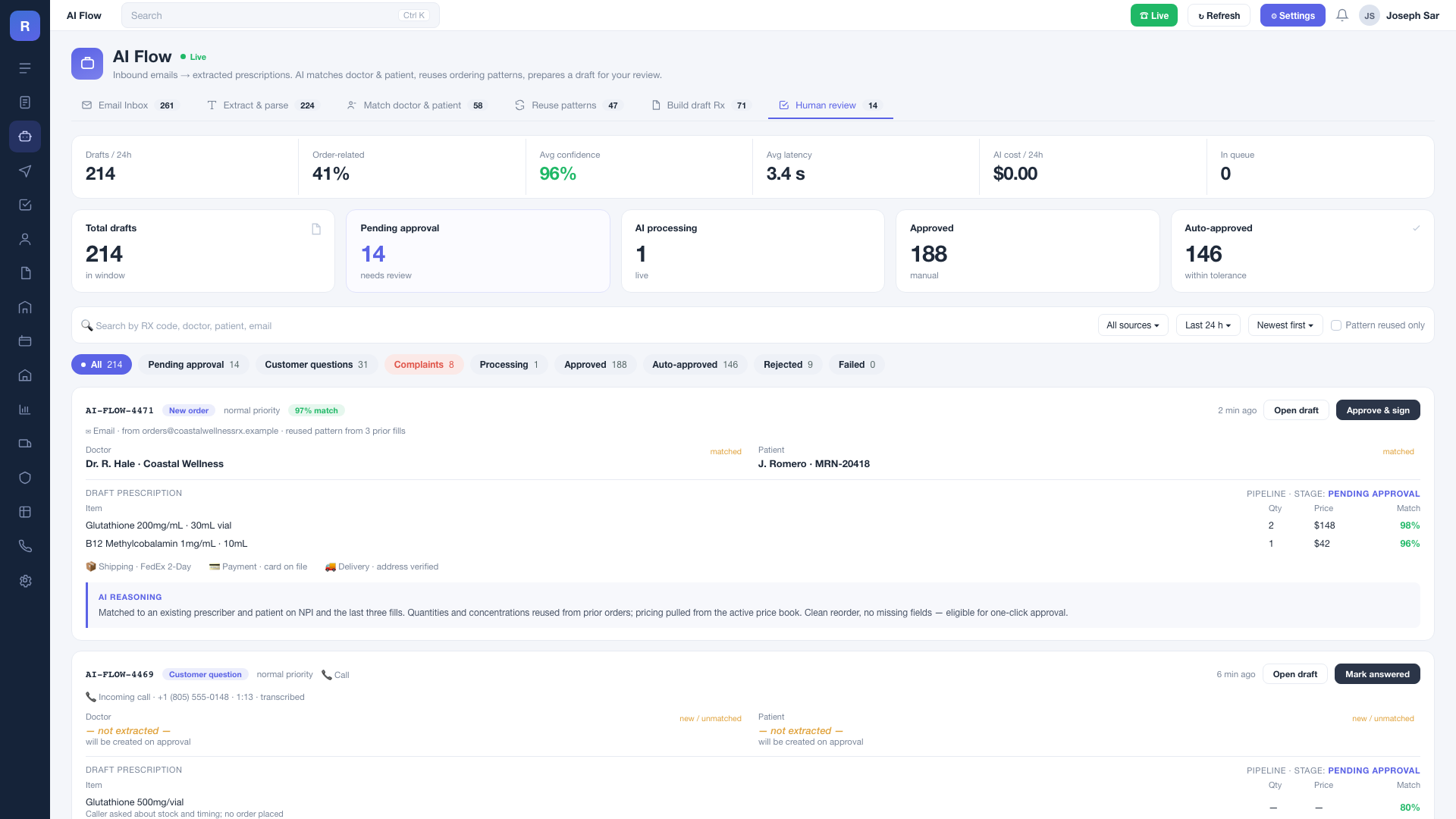
AI Flow: inbound email parsed into a draft prescription, with extraction confidence, a review queue, and complaint handling.
02Call center · prescriber relations

Every call known, answered, categorized.

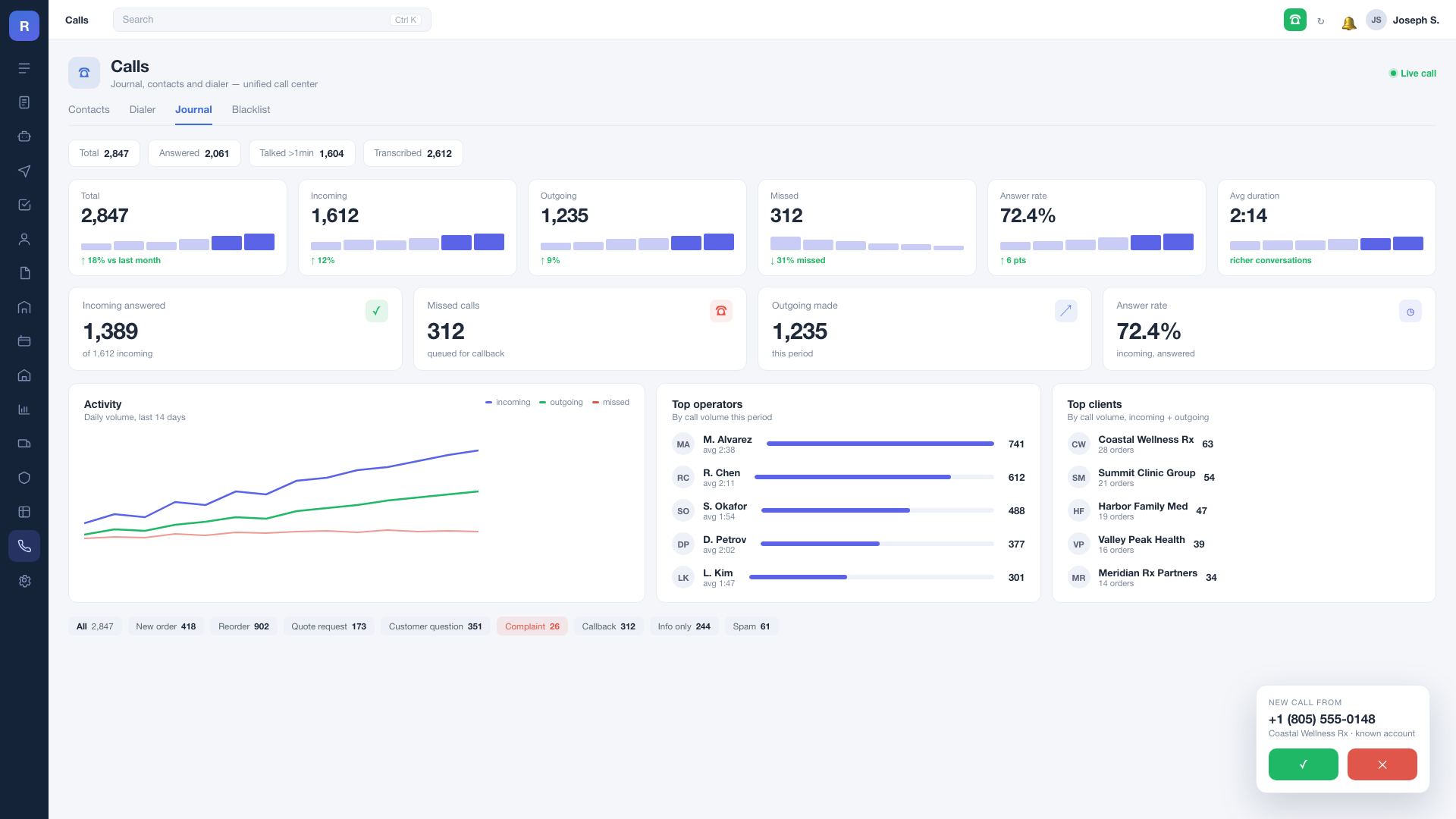
A unified call center: inbound and outbound, transcribed and categorized, with the caller and their history surfaced on connect. Missed calls stopped disappearing: each one becomes a tracked, assigned callback.

  1. 1Known on connect. The system identifies the caller and surfaces their history before the first word, so the rep opens with context rather than questions. HIPAA 45 CFR 164
  2. 2Categorized, not guessed. Every call is classified as a new order, reorder, question, complaint, or callback, so demand and issues are measured, not lost. Demand signal
  3. 3Missed calls become tasks. A missed inbound call opens and assigns a callback by rule, so the backlog clears instead of accumulating. Tracked callbacks
Calls: unified call center with volume, answer rate, top operators and accounts, and call categories including complaints.
03Order intake · correspondence

Orders that live in the system.

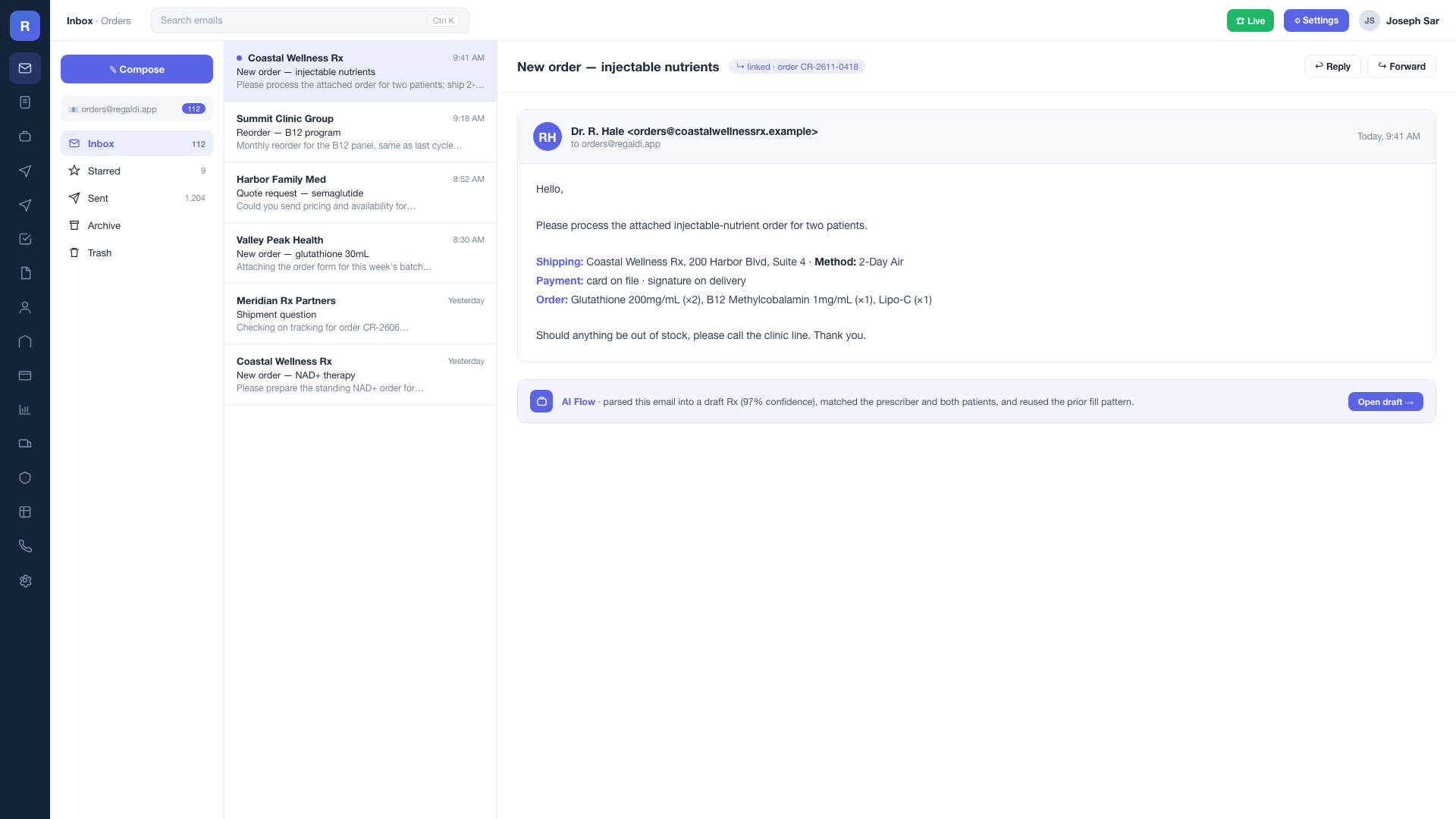
Email runs inside the same database: every order, question, open and click tied to the contact and the order it touches. An incoming order email is one tap from the draft the assistant built from it.

  1. 1One thread, one record. Each message is bound to the contact and the order, so correspondence and history live together, not in a separate mailbox. CAN-SPAM · HIPAA
  2. 2Email into a draft order. An inbound order email is parsed by the assistant into a draft Rx. The operator opens the draft straight from the message. AI Flow
  3. 3Nothing sent without a person. Replies are drafted in the operation’s own voice for staff to review and send: the assistant prepares, the person sends. Under review
Inbox: order emails from prescriber accounts, an order being read, and an AI Flow band linking the email to its extracted draft.
04Lifecycle automation · retention

Refills, segments, and sends that run themselves.

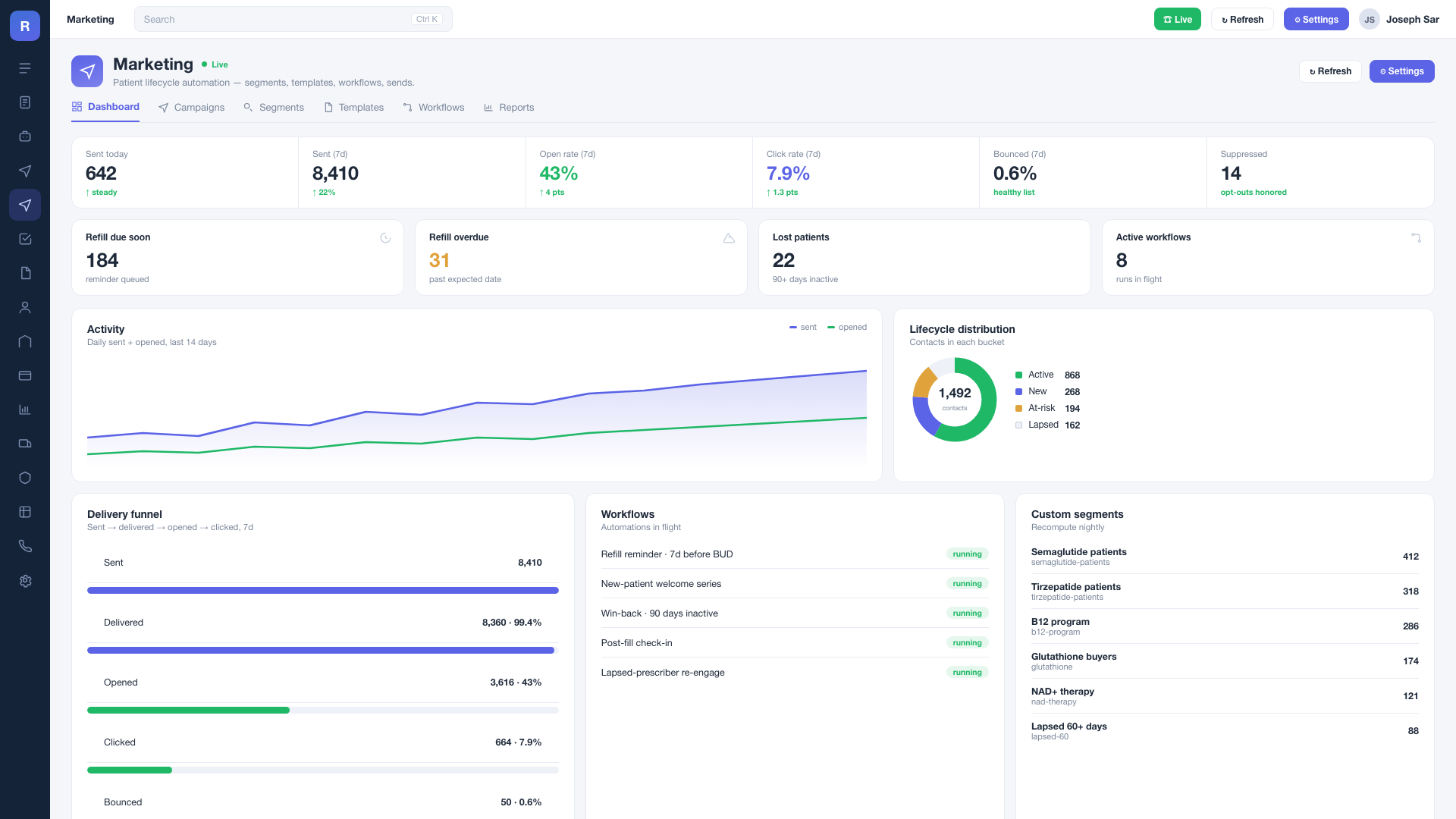
Patient lifecycle automation: who is due for a refill, who is lapsing, which segment to reach, and which message lands. A clean, current list keeps demand flowing without a manual chase.

  1. 1Refills, surfaced early. The system flags who is due and who is overdue and queues the reminder, so a refill is never missed for lack of a follow-up. Retention
  2. 2The funnel, end to end. Sent, delivered, opened, clicked, per send and per segment, so outreach follows real engagement, not a guess. Engagement ledger
  3. 3Workflows in flight. Welcome series, win-back, post-fill check-in: automations run on triggers the pharmacy defines, each bound to a record. Commercial
Marketing: lifecycle dashboard with send and open metrics, refill-due and overdue counts, a delivery funnel, lifecycle distribution, and live workflows.
05Audience building · targeting

Audiences the system builds and keeps current.

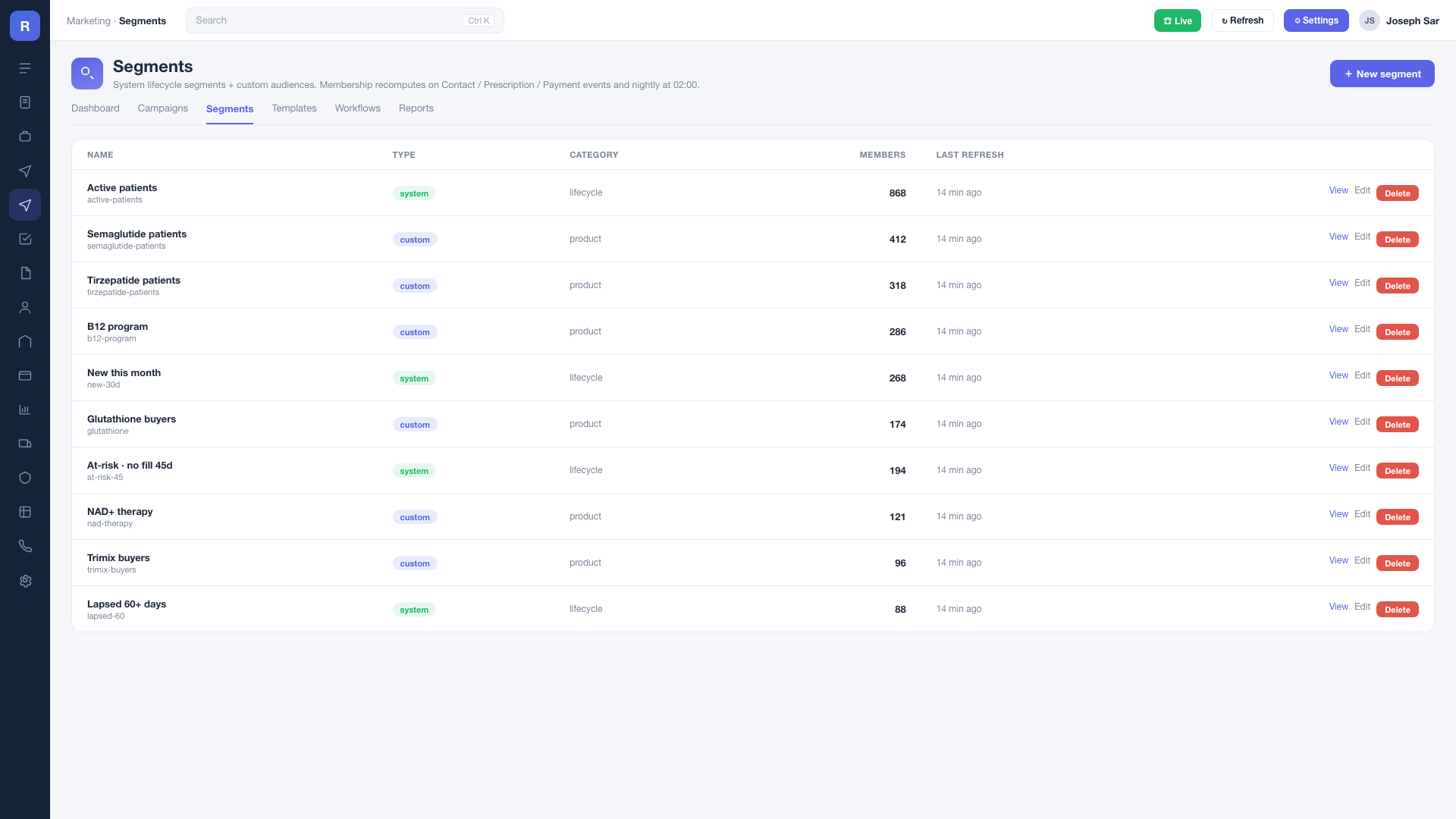
System lifecycle segments and custom audiences recompute on every contact, prescription and payment event, and nightly. A campaign always sends to a current, deduplicated list, never a stale export.

  1. 1Live, not exported. Membership recomputes on events and nightly, so the audience is current at send time: no stale CSV. Anti-Kickback aware
  2. 2System and custom. Lifecycle segments (active, at-risk, lapsed) sit beside product audiences the marketer builds by specialty, product, and behavior. Targeting
  3. 3The unmet-demand map. What customers ask for across calls and email aggregates into segments leadership reads to decide what to add. Demand register
Segments: system lifecycle and custom product audiences with live member counts and recent refresh times.
06Outreach · campaigns

Targeted sends, with a pre-send check.

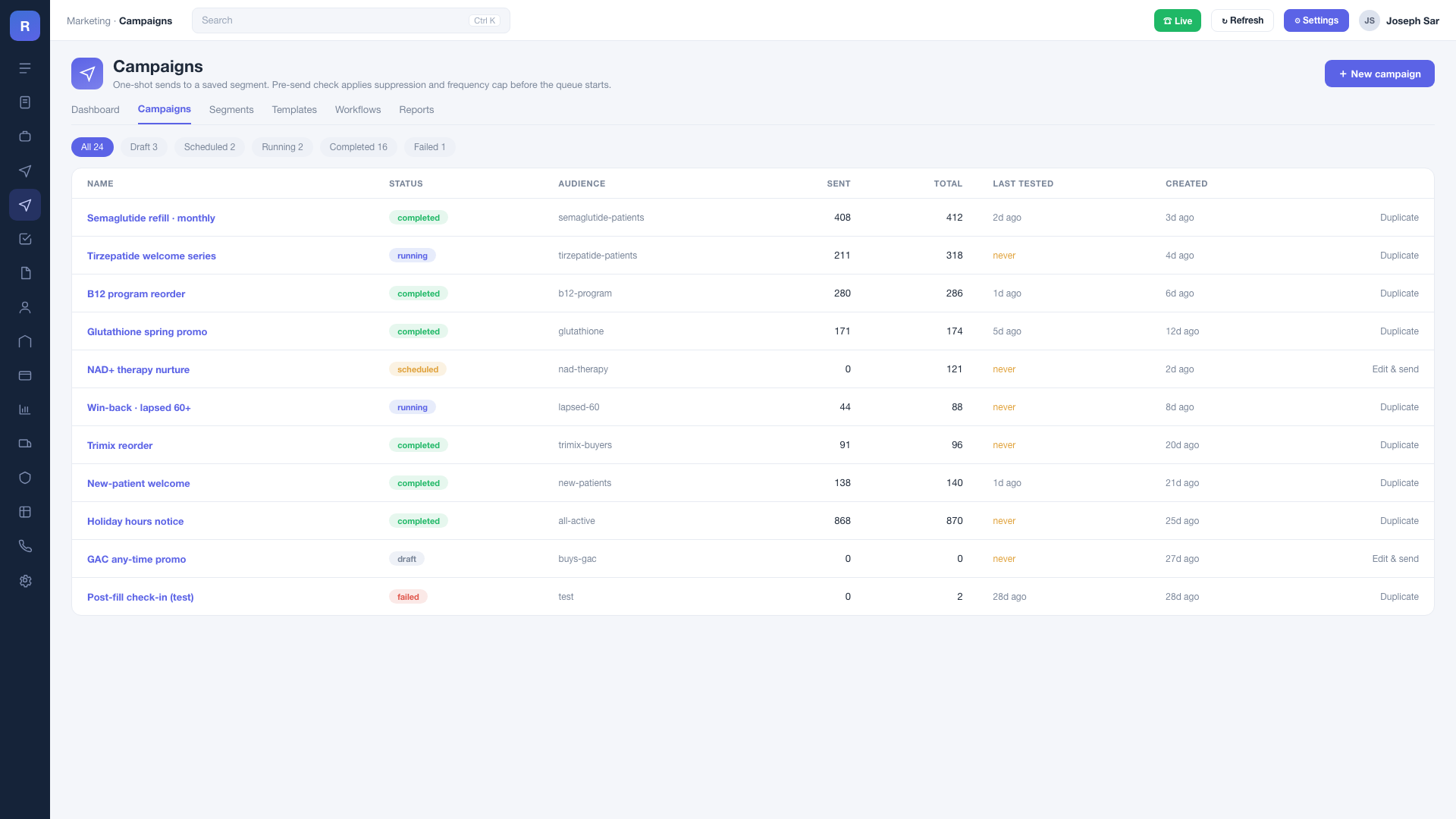
One-shot sends to a saved segment, with suppression and a frequency cap applied before the queue starts, so the right audience hears once, not five times. And each prescription can trace back to the campaign that started it.

  1. 1Suppression first. A pre-send check applies opt-outs and a frequency cap before the queue starts, so no one is over-mailed. CAN-SPAM
  2. 2Sent to a current segment. Each campaign targets a live segment; status (running, scheduled, completed) is visible at a glance. Commercial
  3. 3Campaign → prescription. Each prescription ties back to the campaign and message that started it, recorded at the order line. Attribution
Campaigns: a list of sends to product and lifecycle segments with statuses: completed, running, scheduled, draft.
07Dispensing · verification · release

The dispensing pipeline, to a signed release.

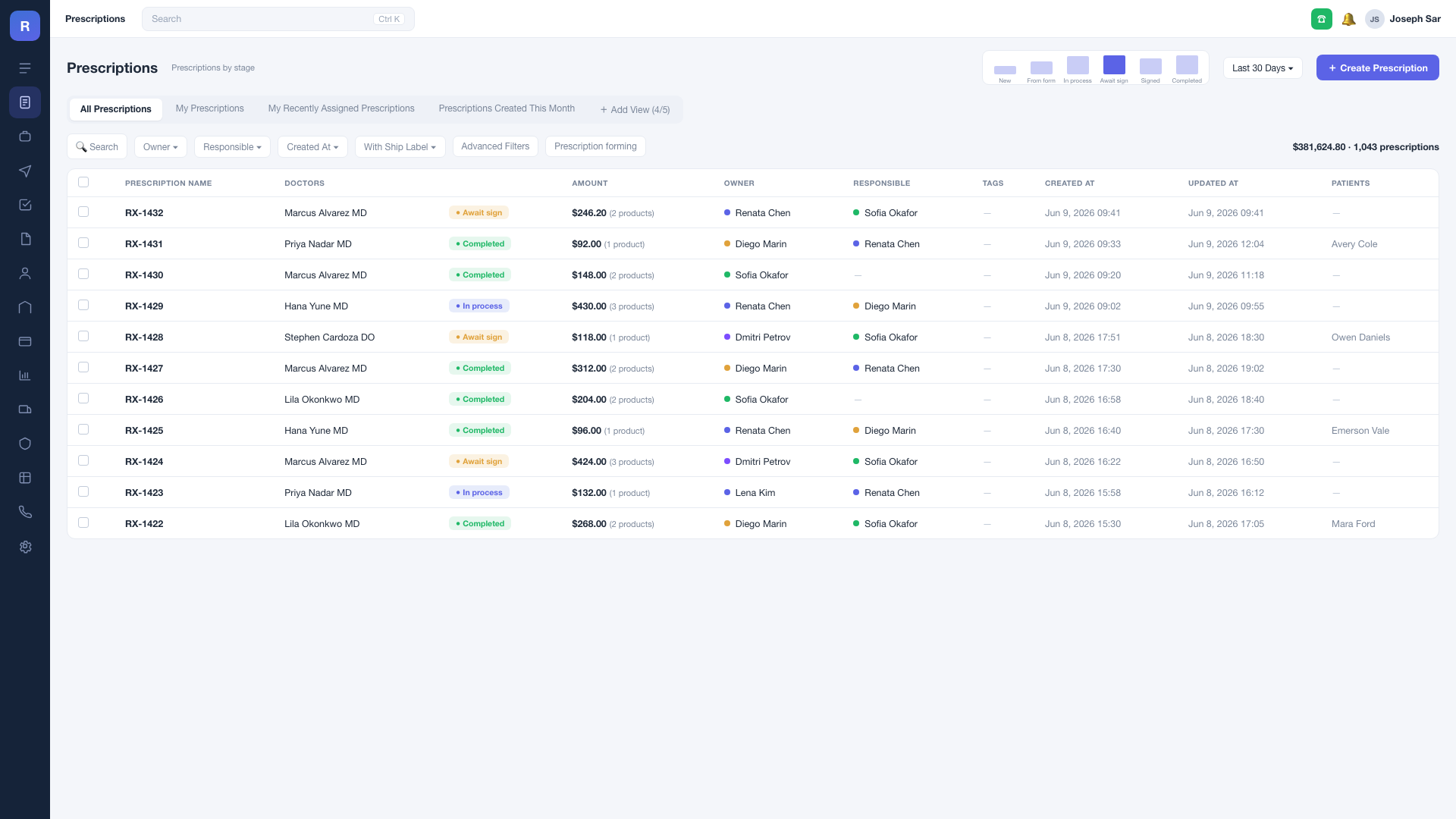
Every order becomes a prescription that moves through a defined pipeline: new, from form, in process, await sign, document signed, completed. The board shows where each one stands and what it is worth, and the pharmacist’s signature is the gate that releases it.

  1. 1A stage for every step. New, from form, in process, await sign, signed, completed. The by-stage view shows the whole book at a glance. Dispensing workflow
  2. 2The signature is the gate. A prescription holds at “await sign” until the verifying pharmacist signs; machine support never substitutes for that signature. Under signature
  3. 3Owner and responsible, on the record. Each carries an owner and a responsible operator, with amount and patient, so accountability is never ambiguous. Accountability
Prescriptions: a pipeline board by stage with amount, owner, responsible, and patient on each prescription.
08Call documentation · consent

Every call transcribed, beside the order.

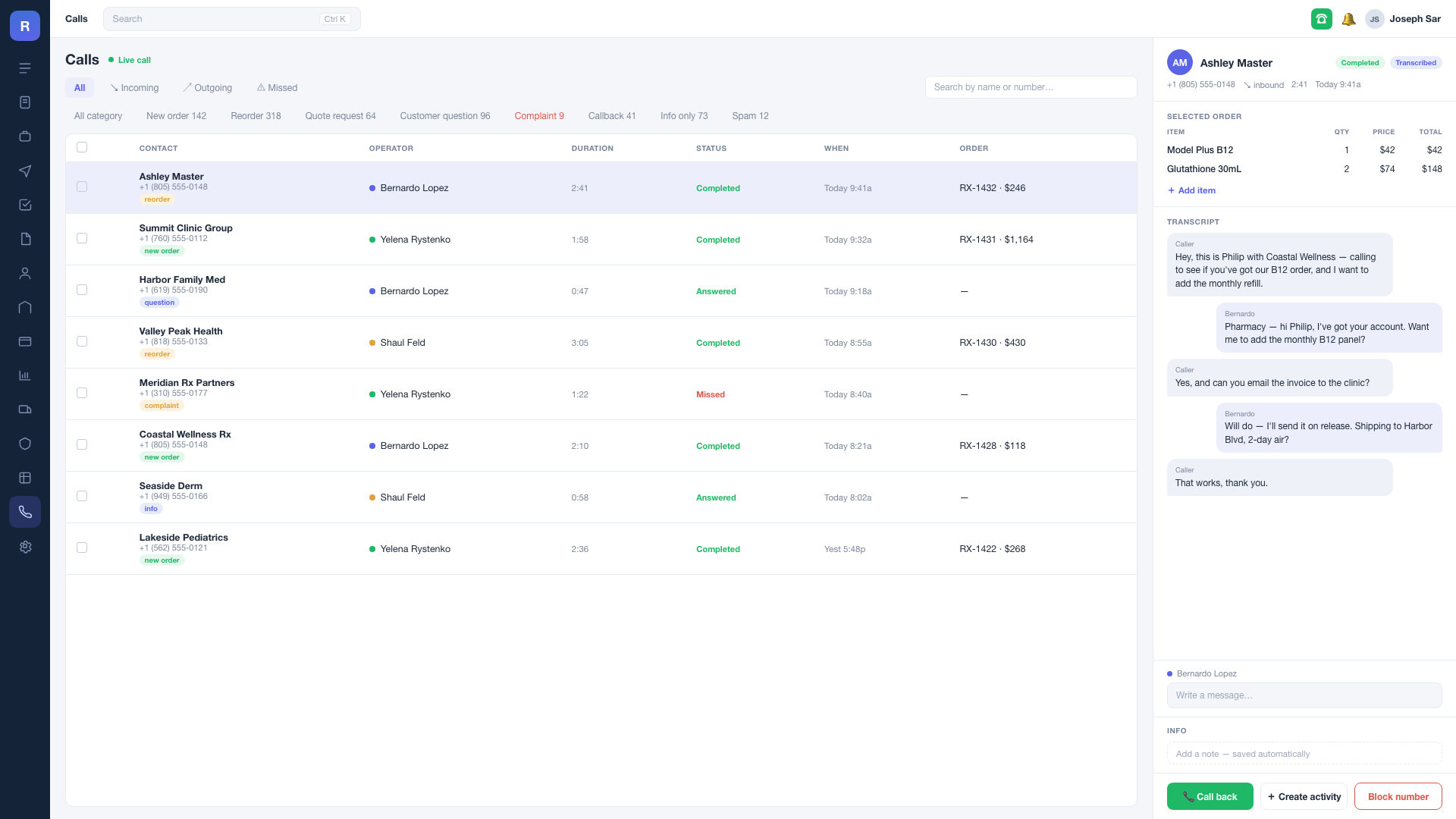
A call opens the contact, the order on the line, and a live transcript side by side. Where consent is on file, the conversation is recorded, transcribed, and bound to the interaction record: a dated, attributable account of what was discussed.

  1. 1Bound to the interaction. The transcript and the order discussed are written to the call record, so the account of the conversation lives with the contact. HIPAA 45 CFR 164
  2. 2Consent, on file. Recording and transcription run only where the pharmacy, as covered entity, has captured the required consent. Recording consent
  3. 3The operator stays in control. Notes and next steps are the operator’s to write and send. The record assists; it does not act on its own. Operational
Calls: a call journal with a detail panel showing the order on the call and a live transcript of the conversation.
09Billing · revenue

Charged on release, reconciled to the record.

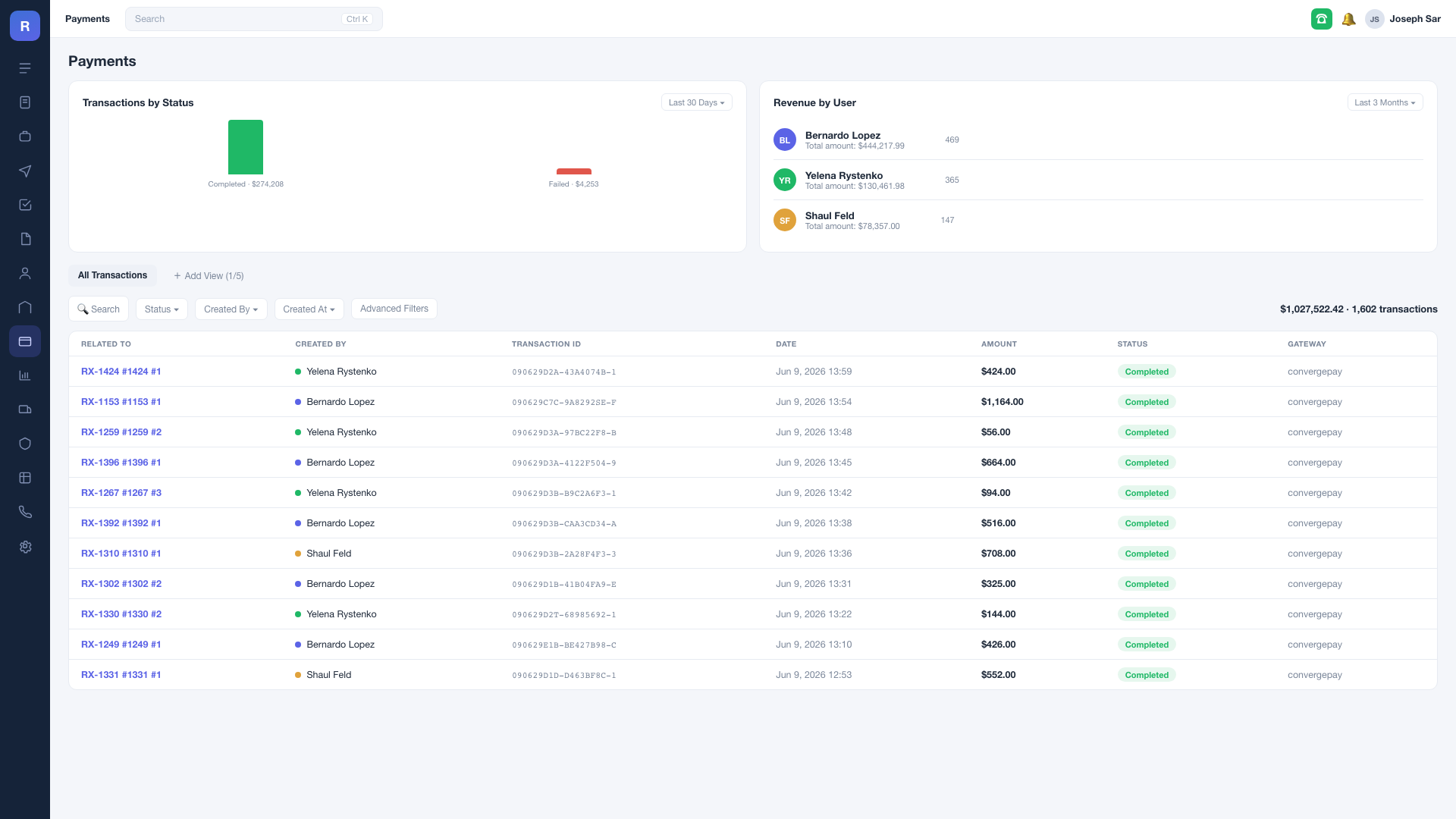
Payment posts against the order on the authorized release event, through the gateway, recorded to the line. Every transaction reconciles back to its prescription, by user and by status, with nothing charged before release.

  1. 1On release, not before. A charge posts on the authorized release event and is bound to the order line, so every payment maps to what shipped. Cardholder data is handled by the payment gateway; the system stores no card numbers. PCI-DSS · no PAN stored
  2. 2Reconciled by record. Each transaction carries its related prescription, gateway, and status, so a billing question resolves against a dated record. Data integrity
  3. 3Revenue, by the numbers. Every dollar attributed by user and status, read from records, not a spreadsheet. Read from records
Payments: transactions by status, revenue by user, and a transaction ledger tied to prescriptions.
10Live operations · results

The whole floor, live.

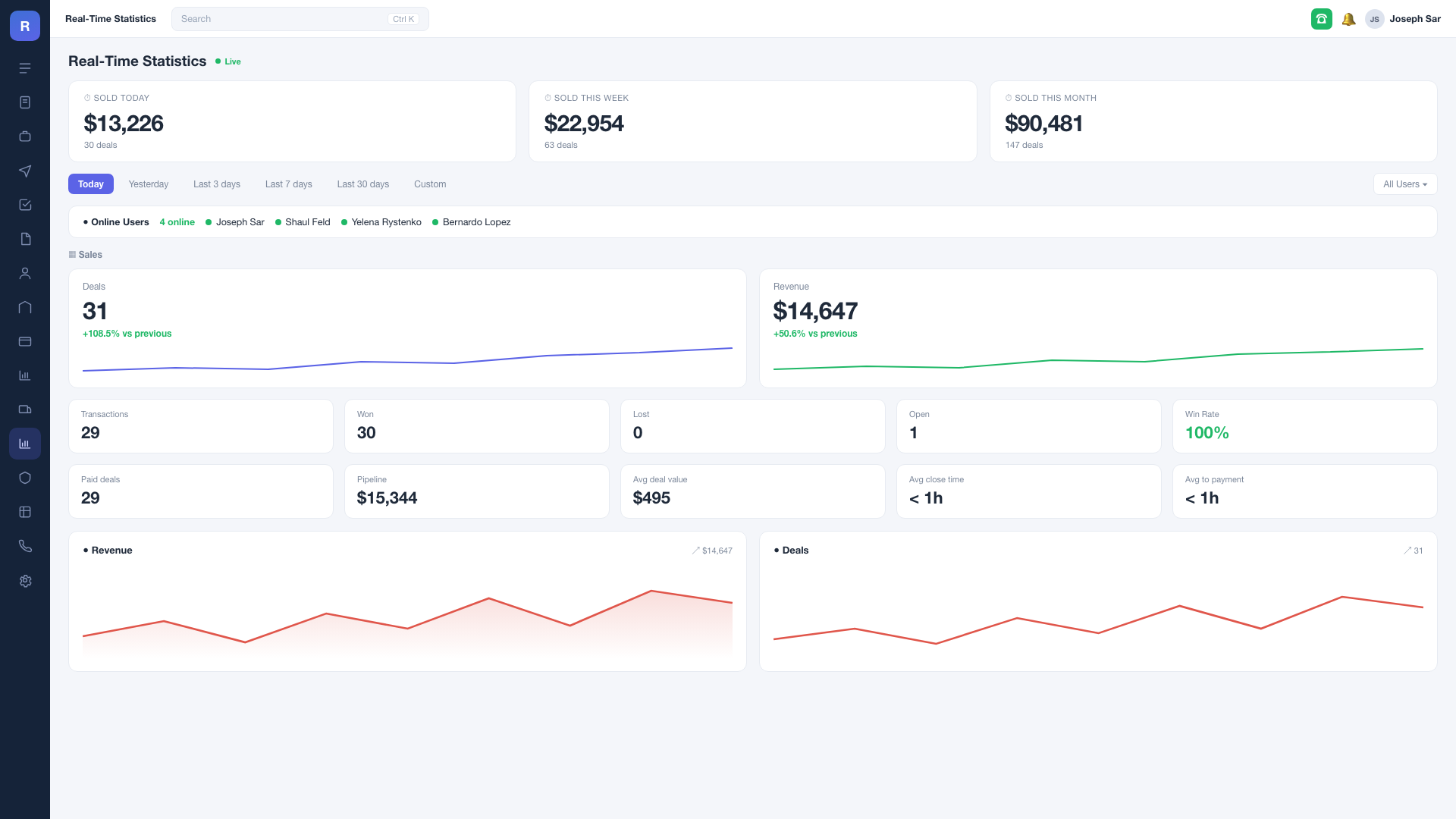
Sold today, this week, this month; deals and revenue against the prior period; win rate, pipeline, and time-to-payment, all updated live. The floor is not reconstructed at month-end; it is watched all day.

  1. 1Growth, measured live. Deals and revenue tracked against the prior period, the month sold read from the live ledger, not a monthly report. Live ledger
  2. 2The full picture. Win rate, pipeline value, average deal value, and time-to-payment sit on one screen for whoever runs the floor. Operational control
  3. 3Who is on, right now. Online operators and their live activity surface here, so the floor is visible in real time. Real-time
Real-Time Statistics: live sold today/week/month, deals and revenue versus prior period, win rate and pipeline, with live charts.
11Fulfillment · distribution

From release to the door.

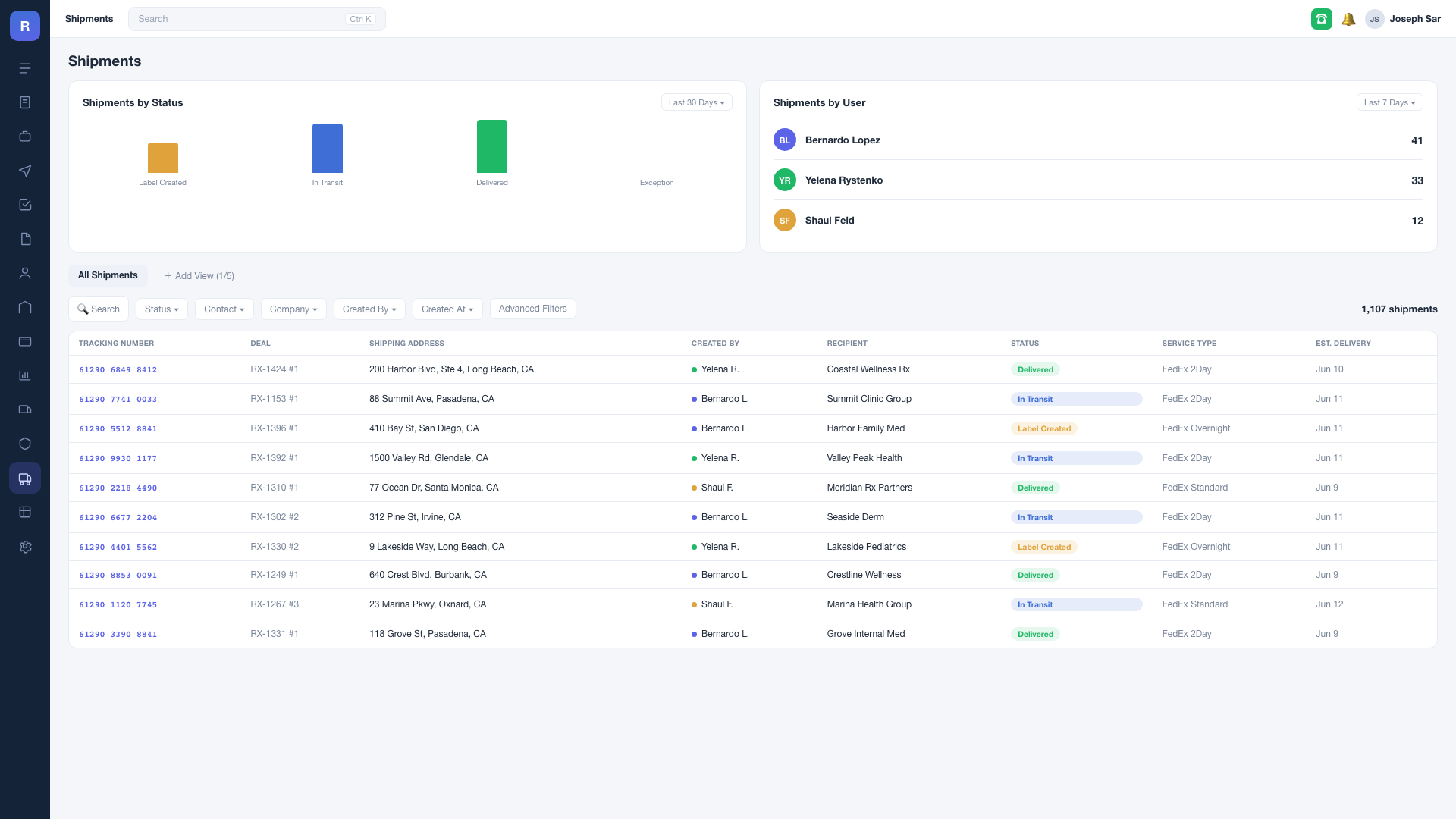
Every released order becomes a shipment with a carrier, a tracking number, and a status (label created, in transit, delivered), bound to its prescription and recipient, so a “where is it?” is answered by query, not by phone.

  1. 1Tracked end to end. Each shipment carries its tracking number, carrier, recipient, and status, tied back to the order it fulfills. Distribution
  2. 2Status at a glance. Label created, in transit, delivered. The board shows the whole floor of shipments and flags any exception. Operational control
  3. 3By the record, not the phone. A delivery question resolves against the shipment record and live carrier status, not a call to the warehouse. Distribution record
Shipments: shipments by status and by user with a tracking ledger of carrier, recipient, status, and service type.
12Records · correspondence

Every invoice, slip, and delivery. On file.

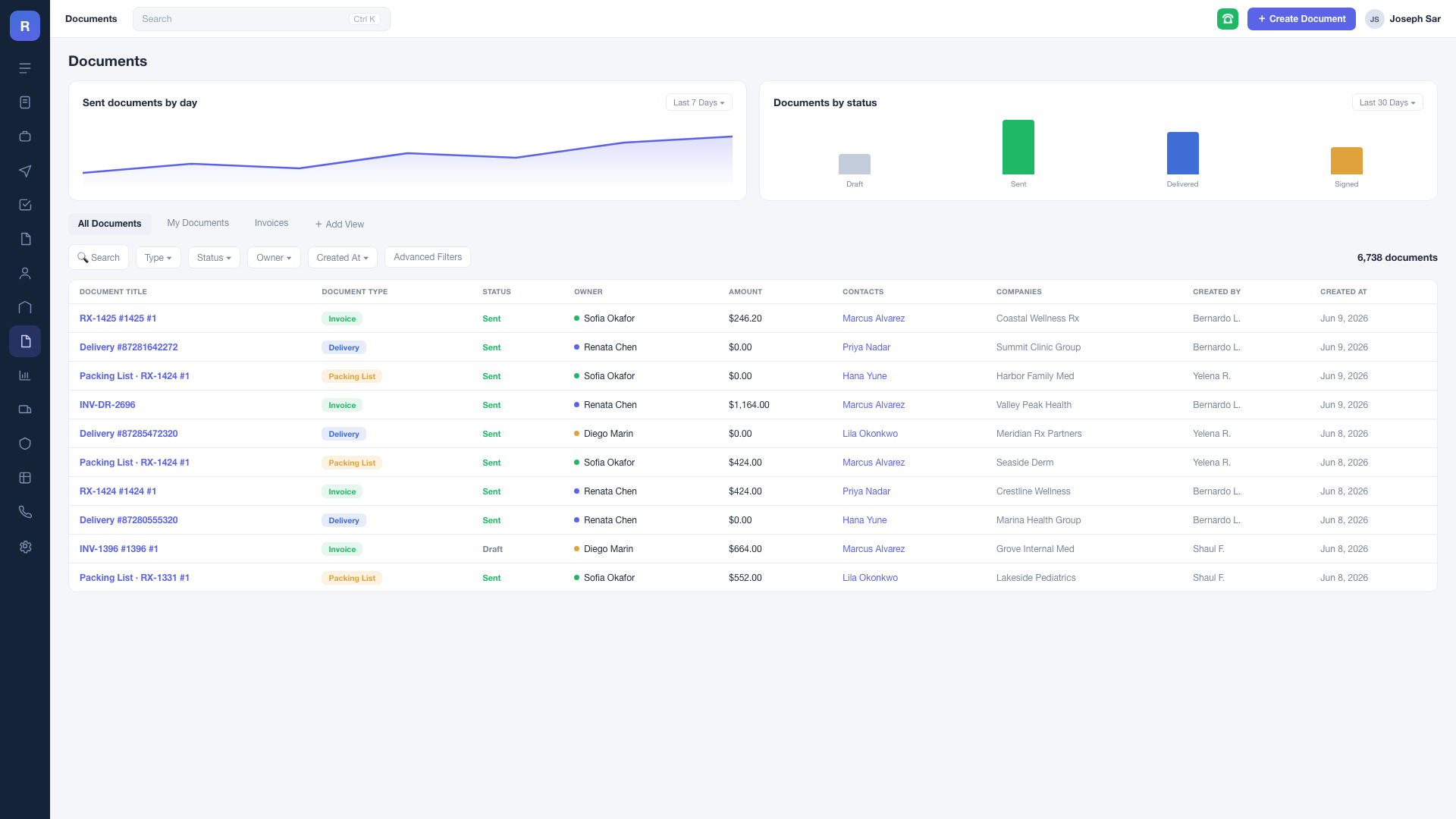
Invoices, packing lists, and delivery documents are generated from the order and bound to the contact and company, with status from draft to sent to signed, so the paperwork is part of the record, not a separate binder.

  1. 1Generated from the order. Invoices, packing lists, and delivery docs are produced from the order data and linked to the contact and company. Records
  2. 2Status, end to end. Draft, sent, delivered, signed. Thousands of documents, each tied to its order. Operational
  3. 3One record, not a binder. The paperwork lives with the order it belongs to, retrievable on demand. Data integrity (ALCOA+)
Documents: invoices, packing lists, and delivery documents with status, tied to contacts and companies.
01

The Order Pipeline: From Order Entry to Shipment

The system structures the full dispensing pipeline of a compounding pharmacy, from order entry and prescriber queue, through data-entry verification, DUR, and final product verification, to release and shipment. At this client's workstation, order-processing time was reduced roughly twentyfold over the engagement by removing manual re-keying between steps, not by shortening any review gate; each state transition is written to a timestamped record the pharmacy can review against its own SOPs.

02

The Prescriber Book: Outreach, Follow-Up, and Attribution

The commercial side runs in the same system as the dispensing floor. The call, the email, the order, the payment: every prescriber interaction resolves to one chronological record, so the next outreach proceeds from the full history rather than a cold screen. Lifecycle segments recompute on every event; campaigns send to a current list with suppression and a frequency cap applied; and each prescription ties back to the campaign and message that started it. The practice serves more than 1,700 active doctors and clinics on this system, and gross revenue doubled over the engagement period.

03

Pre-Call Context: Prescriber and Patient Record Assembly

Before an outbound prescriber or patient call, the system surfaces the relevant record to the operator: the patient medication profile, fill history, any open clarifications, and the order under discussion. The call proceeds against the record rather than a cold screen. Where the pharmacy has configured it, a voice assistant answers inbound calls when every operator is occupied and after hours: it takes the order or the question, and hands the call to a person the moment it calls for a licensed judgment. Every call, human or assisted, is transcribed where consented and closed into a task for the responsible operator.

04

Call Documentation: Transcription and Script-Adherence Review

Where the pharmacy has established the notice and consent required by applicable law, the system can transcribe patient-outreach and refill calls and check them against the approved outreach script, flagging deviations for follow-up; the transcript is then bound to the interaction record as a dated, attributable account of what was discussed. Whether to record or transcribe any call, the consent captured, and the retention period are configured by the pharmacy as the covered entity. The capability is an operational quality tool, not a clinical determination.

05

Live Assistance on the Call: the Whisper at the Operator's Shoulder

While a call is in progress, the assistant keeps the operator supplied: the relevant record, the price book, the prior fills, and the approved outreach script, surfaced as the conversation moves. Where the pharmacy has configured it, the assistant flags a statement that would depart from the approved script before it is made, so the correction happens in the moment rather than in a review after the fact. It runs on the same consented transcription that documents the call. The assistant suggests; the operator speaks, decides, and remains accountable for the call.

06

The Demand Register: What Was Asked For, Not Just What Was Sold

When a caller asks for a preparation the pharmacy does not carry, the request is not lost with the call. The assistant classifies it and writes it to a demand register: the product asked for, how often, and by whom. Leadership reads the register to decide what the pharmacy should add, so the catalog follows measured demand rather than guesswork. And when the preparation is added and released, the register becomes the outreach list: the prescribers who asked for it are the first to hear, through a segment the assistant prepares and the operator or the assistant sends, as the pharmacy configures. Most systems record what was sold; this one also records what was asked for.

07

FEFO Inventory and Beyond-Use Dating

Inventory is rotated First-Expired, First-Out. For compounded preparations, the assigned Beyond-Use Date (BUD), determined under USP General Chapter <797> for sterile and <795> for nonsterile preparations, is surfaced at the point of pick and escalated visually as the date approaches; for the components that go into them, manufacturer expiration and lot are tracked the same way. The operator is shown which to pull first and which short-dated or recalled stock to segregate, supporting the pharmacy's own dating policies.

08

Automated Billing, Shipping, and Correspondence

Routine billing, shipping, and correspondence tasks run under triggers the pharmacy defines, each bound to a reconstructable record. Billing posts against the patient or facility account only on the authorized release event, recorded to the order line; shipping-label generation and carrier dispatch (FedEx, where configured) bind tracking to the shipment record; prescriber notifications and refill outreach follow schedule. Each automated action records who or what initiated it and when, so any billing or shipping question resolves against a dated record.

09

Chain of Custody: Controlled-Substance Reconciliation

The system maintains a chain-of-custody timeline for each order, from receipt of components through compounding, release, and shipment, to support the pharmacy's own recordkeeping and traceability. Controlled-substance dispensing is reconciled against a perpetual inventory, with receipt and dispensing events recorded to the order's timeline in support of the pharmacy's own DEA and state Board of Pharmacy recordkeeping obligations.

10

Preserved Signature Discipline: The PIC as Licensee of Record

At every release, the final-verification signature stays with the verifying pharmacist, and the Pharmacist-in-Charge (PIC) remains accountable for dispensing under the pharmacy's permit. Technicians enter and pick; the pharmacist verifies and releases. Machine-learning support is applied only to reduce error-prone steps where simplification and automation are insufficient on their own, never to substitute for a required pharmacist signature.

Does the system substitute machine judgment for a required pharmacist signature?

No. The final-verification signature remains with the verifying pharmacist, and the Pharmacist-in-Charge remains accountable for dispensing under the pharmacy’s permit. Machine-learning support is applied only to reduce error-prone steps, never to substitute for a required human signature.

Is inventory dating handled to USP Beyond-Use Date conventions?

Yes. For compounded preparations, the assigned Beyond-Use Date, determined under USP General Chapter <797> for sterile and <795> for nonsterile preparations, is surfaced at the point of pick and escalated as the date approaches, with components rotated First-Expired, First-Out on manufacturer expiration and lot.

Does the software contact prescribers or patients autonomously?

Within limits the pharmacy configures. A voice assistant can answer inbound calls when every operator is occupied and after hours, taking the order or the question and handing the call to a person the moment it calls for a licensed judgment; routine outbound contact runs only where the pharmacy has established the required notice and consent. The assistant never makes a clinical determination. Every assisted call is transcribed where consented and bound to the interaction record with a task for the responsible operator.

How is controlled-substance dispensing reconciled?

Controlled-substance dispensing is reconciled against a perpetual inventory, with receipt and dispensing events recorded to the dispensing record in support of the pharmacy’s own DEA and state Board of Pharmacy recordkeeping obligations.

Can the system be deployed at another compounding pharmacy?

Yes. As compounding pharmacy software in the same regulatory class, the product is deployable, under written engagement letter, at additional 503A pharmacies. Each engagement opens with a written process and compliance audit before implementation.

Is call recording and transcription HIPAA-compliant?

No software makes a pharmacy HIPAA-compliant; the pharmacy remains the covered entity. The system provides the controls: recording and transcription run only where the pharmacy has established the notice and consent required by applicable law, including two-party-consent states; the transcript is bound to the interaction record; and the consent captured and the retention period are configured by the pharmacy under its own HIPAA policies.

Can a pharmacy migrate from its current system?

Yes. The written audit that opens each engagement inventories the records in the incumbent system: the prescriber book, patient profiles, prescription history, and open orders. Migration is planned in the engagement letter and verified against the source before cutover, so the history the pharmacy has built is preserved in the new system of record.

Deployable, under engagement letter.

Regaldi Herald is deployable at additional 503A compounding pharmacies in the same regulatory class. Each engagement proceeds under a written scope of work and opens with a process and compliance audit before implementation. To request a confidential capability briefing, write to the principal at office@regaldi.ai. The briefing describes scope, the applicable regulatory framework, prospective deliverables, and timeline.